

Play

Christmas games for every kind of gathering

Twenty-three Christmas games with full rules — party games, games for kids, games that work across three generations, and games needing nothing but the people already in the room. No sign-up, no printing, nothing to buy.
What should we play?

Answer as much or as little as you like — every question is optional.

Who’s playing?
How many?
What sounds good?

Suggested game: Christmas Trivia

A good place to start

Christmas Trivia

Test your Christmas knowledge with festive questions covering traditions, movies, music, food and celebrations from around the world.

Players
2+
Ages
7+
Time
about 20 min
You need
Nothing needed

Why this fits

  • Nothing to gather
  • Keeps everyone involved
  • Easy to play around the table
Play now

Best Christmas Games

If you only try one thing this year, start here.

Christmas Party Games

Up on your feet, with room for a crowd.

Christmas Games for Families

Games a six-year-old and a grandparent can play in the same round.

Christmas Games for Adults

For a grown-up gathering, an office party or a late evening.

Christmas Games for Kids

Youngest players first — every one of these starts at four to six.

Quick & Easy Christmas Games

Nothing to buy, nothing to prepare, twenty minutes or less.

Christmas Games for Large Groups

Built for a full room rather than merely surviving one.

60-Second Christmas Games

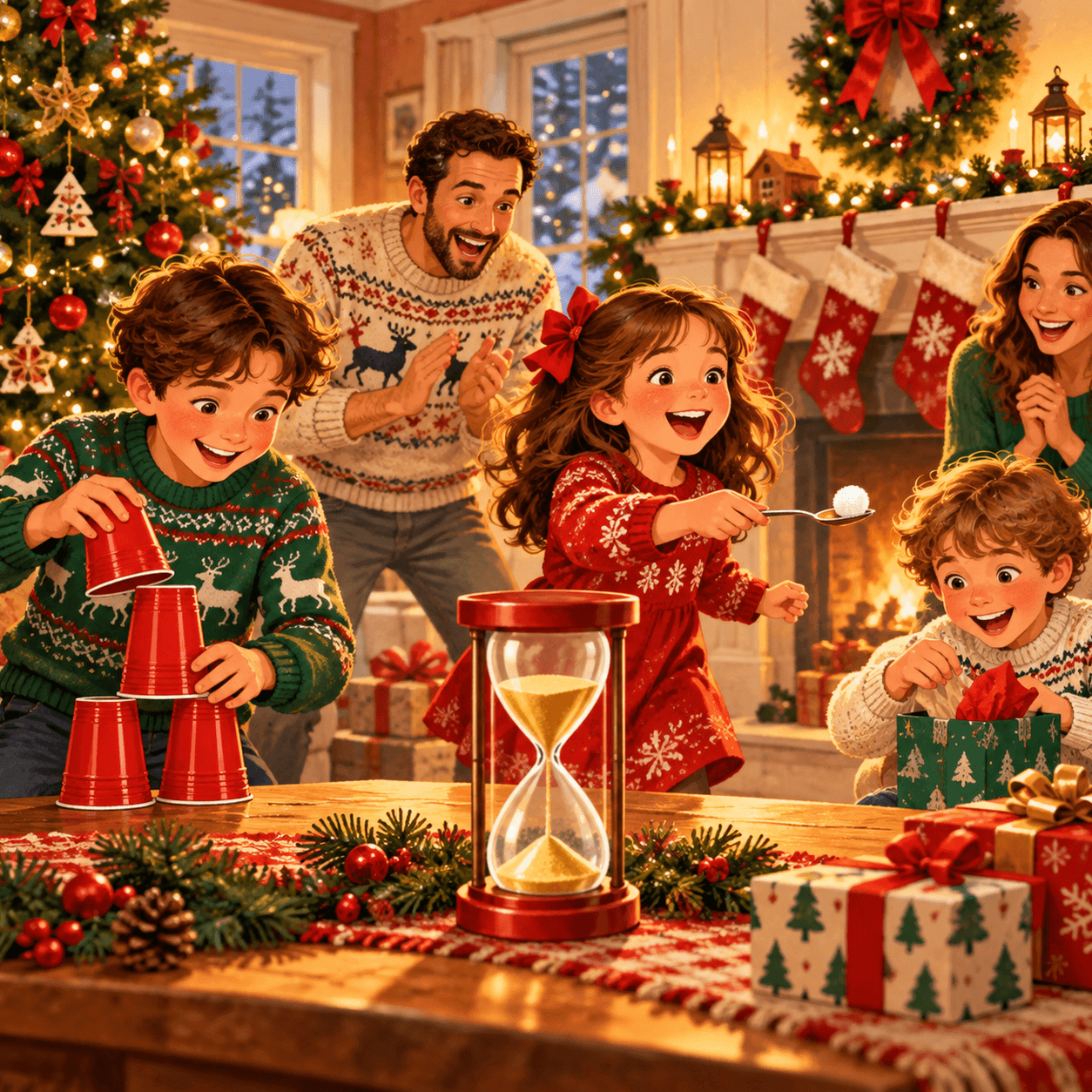
Eight one-minute challenges built from cups, cotton balls, spoons and spare bows — stack, toss, transfer and unwrap against the clock. The full set has its own page.

Play a series of quick Christmas challenges using simple household items, with each round designed to last about one minute.

See all eight challenges

Every Christmas game

All twenty-three, alphabetically, with the full rules for each.

60-Second Christmas Games

Play a series of quick Christmas challenges using simple household items, with each round designed to last about one minute.

Players
2+
Ages
7+
Time
about 25 min

Play 60-Second Christmas Games

How to play 60-Second Christmas Games

What it is

60-Second Christmas Games are a collection of short festive challenges that turn simple household items into fast, competitive party games. Players race the clock to stack, toss, transfer, unwrap or balance Christmas-themed objects, usually with about one minute to complete each challenge.

You can play just a few rounds for a quick burst of activity or combine several challenges into a longer tournament. The format works well for families, larger gatherings and office Christmas parties because the rules are simple, the rounds are short and different types of challenges give different players a chance to shine.

Setting up

Choose the challenges you want to play and gather the materials for those rounds before starting. Clear enough space for players to move safely, divide the group into teams if desired, and decide whether each challenge will be played one player at a time, head-to-head or as a team relay. Use a phone or timer to keep each round to about 60 seconds.

You may need: plastic cups, small wrapped boxes or empty gift boxes, cotton balls or soft pom-poms, spoons, candy canes, jingle bells, gift bows, oven mitts, timer.

How to play

  1. Choose three to eight challenges from the list below, depending on how long you want the game to last.
  2. Explain and demonstrate the first challenge before starting the timer.
  3. Choose whether players will compete individually, head-to-head or in teams.
  4. Start the timer and give players about 60 seconds to complete the challenge or achieve the best result they can.
  5. Award points based on completion, speed or the best score for that challenge.
  6. Reset the materials and move to the next challenge.
  7. Continue until all selected challenges have been played.
  8. Add up the points at the end if you are keeping score. The player or team with the highest total wins.

Rules

  • Use soft, lightweight or unbreakable materials whenever possible.
  • Keep walking and running areas clear of furniture, cords and other obstacles.
  • Do not require players to hold game pieces or utensils in their mouths.
  • Players should use only the method described for each challenge unless a variation is agreed before the round begins.
  • If children are playing, choose challenges and materials appropriate for their age and supervise active rounds.
  • For office groups, avoid challenges that require physical contact or could damage clothing, furniture or equipment.

Winning

Award points for each challenge using one consistent system, such as three points for first place, two for second and one for third. After the final challenge, the player or team with the most total points wins. For a casual version, skip overall scoring and simply celebrate the winner of each round.

The eight challenges

  • Christmas Tree Cup Stack: Stack plastic cups into a Christmas-tree-shaped pyramid and return them to a single stack before time runs out.
  • Present Stack: Build the tallest stable tower you can using small wrapped boxes or empty gift boxes.
  • Snowball Toss: Toss cotton balls or soft pom-poms into a bowl or container from a marked distance and count how many land inside.
  • Snowball Transfer: Use a spoon held in your hand to move cotton balls or soft pom-poms from one container to another without touching them with your fingers.
  • Candy Cane Hook: Hold one candy cane in your hand and use its hook to pick up or move other candy canes into a container.
  • Jingle Bell Transfer: Move jingle bells from one container to another using a spoon or similar handheld utensil.
  • Bow Transfer: Transfer gift bows between two bowls or containers one at a time and count how many you move before time expires.
  • Gift Unwrap Challenge: Wearing oven mitts, unwrap a small securely wrapped empty box as quickly as possible without using your teeth.

Christmas Bingo

Mark festive pictures or words on your bingo card as they are called, and be the first player to complete the winning pattern.

Players
2+
Ages
5+
Time
about 20 min
How to play Christmas Bingo

What it is

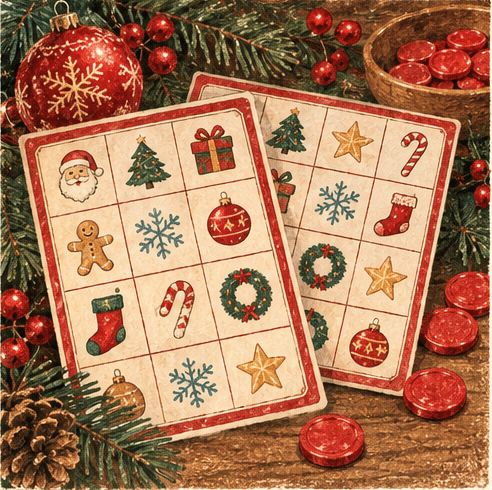
Christmas Bingo gives the classic bingo format a festive theme using Christmas words, pictures or both. Each player receives a different card, and a caller announces Christmas items one at a time while players mark matching spaces and watch for the winning pattern.

The game is easy to understand, works across generations and lets everyone participate at the same time. Picture-based cards are especially useful for younger children, while word-based or more varied cards work well for families, adults and office Christmas parties.

Setting up

Prepare a different Christmas bingo card for each player and a matching caller list or set of calling cards. Give each player a card and enough markers to cover its spaces. Before starting, choose the winning pattern—such as a horizontal, vertical or diagonal line—and make sure everyone knows whether the center space, if present, is free.

You may need: Christmas bingo cards, caller list or calling cards, bingo markers.

How to play

  1. Give each player a Christmas bingo card and a set of markers.
  2. Choose one person to be the caller and give them the caller list or shuffled calling cards.
  3. The caller announces one Christmas item at a time.
  4. Players check their own cards and cover the matching space if it appears.
  5. Continue calling items until a player completes the agreed winning pattern and calls out "Bingo!"
  6. Pause the game and check the winning card against the items that have already been called.
  7. If the card is correct, that player wins the round. Clear the cards and play again if the group wants another round.

Rules

  • Players may mark only items that have already been called.
  • Each player should use a different card whenever possible so everyone does not complete the same pattern at once.
  • The winning pattern must be agreed before the round begins.
  • When a player calls Bingo, check every marked space in the winning pattern against the caller record.
  • If a Bingo is incorrect, continue the round with the existing cards and called items.
  • For younger children, use pictures or easily recognizable Christmas words appropriate for their age.

Winning

The first player to complete the agreed pattern and correctly call Bingo wins the round. For a longer game, play several rounds with different patterns and award one point for each round won.

Variations

  • Picture Bingo: Use Christmas pictures instead of written words, making the game easier for younger children and early readers.
  • Four Corners: Instead of completing a line, players must cover all four corner spaces to win.
  • Full Card: Keep calling until a player has covered every space on their card.
  • Christmas Movie Bingo: Fill the cards with Christmas movie characters, objects and familiar festive situations.

Christmas Categories

Race to think of Christmas words that fit a list of categories and begin with the chosen letter before time runs out.

Players
2–12
Ages
8+
Time
about 20 min
How to play Christmas Categories

What it is

Christmas Categories is a fast word game in which everyone tries to think of festive answers that fit the same categories and begin with the same letter. A round might ask for a Christmas food, a gift, a song, a decoration and something associated with winter, with players racing to fill as many categories as they can before time runs out.

The game works well with families, friends and coworkers because everyone plays at the same time and the rules are easy to adjust. Familiar categories make it accessible to younger players, while unusual letters and more specific categories can make later rounds much harder.

Setting up

Give each player a sheet of paper and a pen or pencil. Prepare a short list of Christmas-themed categories that everyone will use, then choose a letter for the first round. Decide how long players will have to answer; about two minutes works well. Before starting, agree whether closely related answers count and whether proper names are allowed.

You may need: paper, pens or pencils, Christmas category list, timer.

How to play

  1. Give every player the same list of Christmas categories.
  2. Choose one letter that answers should begin with for the round.
  3. Start the timer and have everyone write one answer for as many categories as possible.
  4. When time expires, everyone stops writing.
  5. Read the categories one at a time and have players share their answers.
  6. Award one point for each valid answer that no other player wrote.
  7. Choose a new letter and play another round using the same categories or a fresh list.
  8. After the agreed number of rounds, add up the points. The player with the highest total wins.

Rules

  • Each answer must fit the category and begin with the chosen letter.
  • Players may write only one answer for each category in a round.
  • An answer scores only if the group accepts it as a reasonable match for the category.
  • If two or more players wrote the same answer for a category, none of those matching answers earns a point.
  • Different forms of essentially the same answer should normally be treated as duplicates unless the group agrees otherwise.
  • Choose letters and categories appropriate for the age and Christmas knowledge of the people playing.

Winning

Players earn one point for each valid answer that no other player used. After the agreed number of rounds, the player with the most points wins. If there is a tie, play one additional category with a new letter; the first tied player to give a valid unique answer wins.

Variations

  • Family Version: Use broad categories such as Christmas foods, decorations, gifts, songs, characters and winter activities.
  • Team Categories: Divide a larger group into teams and let teammates work together on one answer sheet.
  • Quick Round: Use five categories and a 60-second timer for a faster game.
  • No-Letter Version: Skip the starting letter and ask players to write as many different answers as possible for one Christmas category before time expires.

Christmas Charades

Act out Christmas characters, traditions, songs and festive activities while your teammates race to guess the answer.
Players
4+
Ages
6+
Time
about 20 min

Play Christmas Charades

How to play Christmas Charades

What it is

Christmas Charades turns the classic acting game into an easy Christmas party activity. Players take turns silently acting out festive prompts while their teammates try to guess what they are portraying before the turn ends.

It works especially well with families, groups of friends and office Christmas parties because the rules take seconds to learn and the prompts can be adapted to almost any age group. All you need are some Christmas-themed ideas, slips of paper and people willing to perform.

Setting up

Write Christmas-themed prompts on small slips of paper, fold them and place them in a bowl or container. Divide the group into two teams and decide how long each acting turn will last; about one minute works well. Mix familiar prompts such as decorating a Christmas tree or building a snowman with characters, traditions and other festive ideas appropriate for your group.

You may need: small slips of paper, pens or pencils, bowl or container.

How to play

  1. Divide the group into two teams and place all of the folded Christmas prompts in a bowl or container.
  2. Choose one player from the first team to act and have them draw a prompt without showing it to anyone else.
  3. The actor silently performs the prompt while their teammates try to guess the answer.
  4. When the team guesses correctly, award one point. If time remains, the actor may draw another prompt and continue.
  5. When time runs out, switch teams and choose a new actor.
  6. Continue taking turns until everyone has had a chance to act or the group has played the agreed number of rounds.
  7. Add up the points at the end of the game. The team with the most points wins.

Rules

  • Actors may use gestures and body movements but may not speak, mouth words or make sound effects.
  • Actors may not spell words in the air, point to written words or letters, or use nearby objects to reveal the answer directly.
  • Teammates may make as many guesses as they like while the turn is active.
  • A prompt counts only when the team identifies the intended answer before time runs out.
  • Use prompts that are appropriate for everyone playing, especially with children or coworkers.

Winning

Each correctly guessed prompt earns one point. After the final round, the team with the most points wins. If the scores are tied, give each team one final prompt; the team that guesses its prompt in the shortest time wins.

Variations

  • Family Charades: Use simple prompts that children and adults can recognize and let younger players act with a partner if they prefer.
  • Christmas Movie Charades: Use only characters, titles and memorable situations from Christmas movies and television specials.
  • Christmas Song Charades: Act out the title or idea of a Christmas song without singing, humming or quoting lyrics.
  • No-Score Charades: Skip teams and points entirely. Take turns acting while the whole group guesses, making the game more relaxed and less competitive.

Christmas Drawing Game

Draw Christmas characters, objects and festive activities while your teammates race to guess what they are.

Players
4+
Ages
6+
Time
about 20 min
How to play Christmas Drawing Game

What it is

Christmas Drawing Game is a festive drawing-and-guessing game in which players try to communicate Christmas-themed prompts using pictures instead of words. One player draws while their teammates race to identify the Christmas character, object, tradition or activity before the turn ends.

No artistic skill is required—in fact, unexpected drawings are often what make the game funniest. It works well for families, friends and office Christmas parties, and the prompts can easily be adjusted for the ages and Christmas knowledge of the group.

Setting up

Write Christmas-themed prompts on small slips of paper, fold them and place them in a bowl or container. Divide the group into two teams, provide paper or a drawing surface and something to draw with, and decide how long each turn will last; about one minute works well. Choose familiar prompts appropriate for the people playing.

You may need: paper or drawing board, pens, pencils or markers, small slips of paper, bowl or container.

How to play

  1. Divide the group into two teams and place the folded Christmas prompts in a bowl or container.
  2. Choose one player from the first team to draw and have them select a prompt without showing it to anyone else.
  3. Start the turn and have the player draw clues for the prompt while their teammates try to guess the answer.
  4. If the team guesses correctly before the turn ends, award one point.
  5. Switch teams and choose a new player to draw.
  6. Continue alternating turns until everyone has drawn or the group has completed the agreed number of rounds.
  7. Add up the points after the final round. The team with the most points wins.

Rules

  • The person drawing may not speak, mouth words or make sound effects.
  • Do not write letters, words, numbers or recognizable abbreviations as clues.
  • The person drawing may not use gestures to act out the answer; clues should come from the drawing.
  • Teammates may make as many guesses as they like while the turn is active.
  • A prompt scores only if the team identifies the intended answer before time runs out.
  • Use prompts that are appropriate for everyone playing, especially with children or coworkers.

Winning

Each correctly guessed prompt earns one point. After the final round, the team with the most points wins. If the scores are tied, give each team one final prompt and use the fastest correct guess as the tiebreaker.

Variations

  • Family Drawing Game: Use simple Christmas objects, characters and activities that younger players can recognize.
  • Christmas Movie Drawing Game: Use characters, objects and situations associated with Christmas movies and television specials.
  • One-Line Drawing: Once the player starts drawing, they may not lift the pen or marker from the drawing surface until the team guesses or time expires.
  • No-Score Drawing: Skip teams and points and let the whole group guess each drawing for a more relaxed version.

Christmas Emoji Challenge

Decode Christmas songs, movies, characters and festive phrases represented by combinations of emoji.

Players
2–20
Ages
8+
Time
about 15 min
How to play Christmas Emoji Challenge

What it is

Christmas Emoji Challenge turns familiar Christmas ideas into visual puzzles made from emoji. Players study each clue and try to work out the Christmas song, movie, character, tradition or festive phrase represented by the symbols.

Everyone can solve the clues at the same time, so the game works well with families, friends, classrooms and office Christmas parties without putting individual players on the spot. Use straightforward emoji combinations for younger groups or more indirect clues when you want a harder challenge.

Setting up

Prepare a set of Christmas emoji clues with one intended answer for each puzzle. Give each player or team paper and something to write with, or display the clues where everyone can see them. Decide whether players will solve a fixed number of clues at their own pace or receive a short time limit for each one.

You may need: Christmas emoji clues, paper, pens or pencils.

How to play

  1. Give every player or team access to the first Christmas emoji clue.
  2. Players study the emoji and decide what Christmas song, movie, character, tradition or phrase they represent.
  3. Have players write down their answer without showing it to the other players.
  4. Reveal the correct answer after everyone has responded or the time limit expires.
  5. Award one point for each correct answer.
  6. Continue with the remaining emoji clues.
  7. After the final clue, add up the points. The player or team with the highest score wins.

Rules

  • Each emoji puzzle should have one intended Christmas-themed answer.
  • Players should not search online for answers while a clue is active.
  • Agree before starting whether close wording or alternate versions of a title will count as correct.
  • If playing individually, players should keep their answers private until the clue is closed.
  • For mixed-age groups, use clues based on Christmas references that everyone can reasonably be expected to recognize.
  • If an emoji renders differently on different devices, describe or display the clue consistently for everyone playing.

Winning

Award one point for each correctly decoded emoji clue. After the final puzzle, the player or team with the most points wins. If there is a tie, use one additional emoji clue as a tiebreaker.

Variations

  • Christmas Movie Challenge: Use only Christmas movie titles, characters and familiar movie-related ideas.
  • Christmas Song Challenge: Use emoji clues representing the titles of familiar Christmas songs.
  • Team Challenge: Divide a larger group into teams and let teammates discuss each clue before submitting one answer.
  • Create Your Own: After playing the prepared clues, let each player invent a Christmas emoji puzzle for the rest of the group to solve.

Christmas Freeze Dance

Dance to Christmas music and freeze the instant it stops—anyone caught moving has to sit out or take a festive challenge.

Players
3–20
Ages
4+
Time
about 15 min
How to play Christmas Freeze Dance

What it is

Christmas Freeze Dance is an active party game in which everyone dances while Christmas music plays and freezes as soon as the music stops. The challenge is simple: stop moving immediately and hold your position until the music starts again.

It is especially good for children and families because there is almost nothing to explain and everyone can join in at the same time. A short game can burn off some Christmas excitement between quieter activities, while a longer version can continue until only one dancer remains.

Setting up

Choose a clear area with enough room for everyone to move safely and have a device ready to play Christmas music. Choose one person to control the music and explain what happens when someone is caught moving after it stops. Players can be eliminated, lose a point or simply complete a harmless festive challenge before rejoining.

You may need: device for playing music.

How to play

  1. Have everyone spread out in the playing area with enough room to move without bumping into another player.
  2. Choose one person to control the Christmas music.
  3. Start the music and have everyone dance.
  4. Stop the music at an unpredictable moment.
  5. As soon as the music stops, every dancer must freeze and remain still.
  6. Anyone clearly caught moving receives the agreed consequence for that round.
  7. Start the music again and continue alternating between dancing and freezing.
  8. Keep playing for the agreed amount of time or until one player remains in an elimination version.

Rules

  • Players must stop moving as soon as the music stops.
  • The person controlling the music should vary the length of each dancing period so players cannot predict when it will stop.
  • Give players enough personal space and keep the dancing area clear of furniture, cords and fragile objects.
  • Do not require difficult poses, physical contact or movements that could make someone fall.
  • If young children are playing, use a forgiving standard for small movements after the music stops.
  • Players who prefer not to be eliminated can use a points or rejoin version instead.

Winning

In the elimination version, the last dancer remaining wins. For a non-elimination version, award one point for each successful freeze and give the highest score to the player with the most points at the end.

Variations

  • No-Elimination Freeze Dance: Nobody sits out. Players who move simply lose a point or skip one short dancing round.
  • Christmas Character Dance: Before each round, choose a festive character or idea and have everyone dance like it until the music stops.
  • Kids Version: Let children rejoin immediately after being caught moving so nobody stays out of the game for long.
  • Team Freeze: Divide players into teams and award a point to a team whenever all of its dancers freeze successfully.

Christmas I Spy

Take turns choosing a visible Christmas object and giving clues while everyone else tries to guess what you can see.

Players
2–10
Ages
4+
Time
about 15 min
How to play Christmas I Spy

What it is

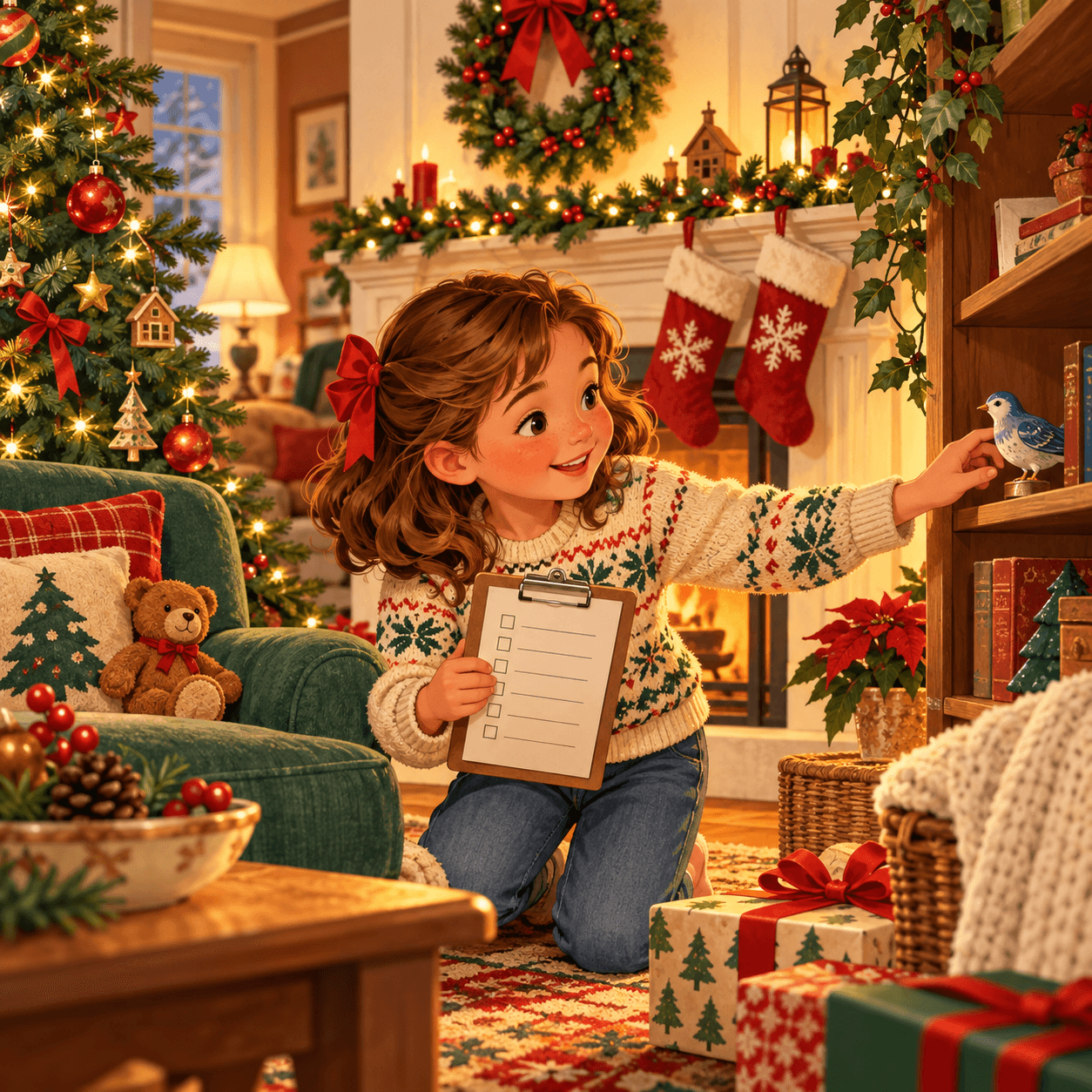
Christmas I Spy is a simple observation game in which one player secretly chooses a Christmas-related object or detail that everyone can already see and gives a clue about it. The other players look around from where they are and try to identify the chosen object before the clue-giver reveals it.

Because nothing needs to be prepared, hidden or collected, the game works well as a quick activity around a table, in a living room or at a workplace gathering. Younger children can use obvious colors and objects, while older groups can make the clues more specific or choose smaller festive details that are harder to notice.

Setting up

No materials or preparation are required. Gather where everyone has a reasonably similar view of the room or table and agree on which visible area is in play. Christmas decorations, wrapped gifts, table settings, clothing and other clearly visible festive details can all be used. Choose a first clue-giver and agree on the order in which the clue-giver role will rotate.
How to play

  1. The clue-giver silently chooses one visible Christmas object or detail within the agreed area.
  2. Without pointing at it or naming it, the clue-giver gives one simple clue, such as its color, shape or location.
  3. The other players take turns making guesses.
  4. If nobody guesses correctly, the clue-giver gives another clue.
  5. Continue giving clues and taking guesses until someone identifies the chosen object.
  6. After the round ends, pass the clue-giver role to the next player in the agreed order.
  7. Continue until everyone has had a chance to be the clue-giver, then keep playing if the group wants more rounds.

Rules

  • Choose only something that was already visible when the round began.
  • The chosen object must be within the agreed play area and reasonably visible to the other players.
  • Do not move, uncover or reposition objects to make a clue work.
  • The clue-giver may describe features such as color, shape, size, position or use, but should not say any part of the object’s name.
  • Players should make one guess at a time so everyone has a chance to participate.
  • Do not point, stare deliberately at the chosen object or otherwise reveal it through gestures.
  • Each player should have a turn as clue-giver before anyone takes a second clue-giver turn.
  • Keep clues appropriate for the ages and setting of the group.

Variations

  • Color Clues: Begin every round with the traditional format, “I spy with my little eye something…” followed by a color.
  • Kids Version: Use large, familiar objects such as a Christmas tree, stocking, present or Santa decoration.
  • Detail Hunt: Choose small visible details such as a star on wrapping paper, a bell on a decoration or a snowflake on a card.
  • Three-Clue Limit: The clue-giver may give at most three clues before revealing the answer and starting a new round.

Christmas Scavenger Hunt

Race to find Christmas decorations, festive objects and hidden clues around the house or another safe playing area.

Players
2+
Ages
6+
Time
about 30 min
How to play Christmas Scavenger Hunt

What it is

Christmas Scavenger Hunt sends players searching for festive objects, decorations or clues instead of keeping everyone gathered around a table. Players can work individually or in teams as they move through the playing area trying to find everything on a Christmas-themed list or follow a sequence of clues to a final destination.

The game works especially well for families and children because it combines a simple challenge with plenty of movement. It can be adapted to the space available, from a quick hunt around one home to an outdoor search for Christmas decorations, and the difficulty can be adjusted by changing what players need to find.

Setting up

Choose the area where the hunt will take place and decide whether players will search from a list or follow prepared clues. Create the hunt before the game begins, making sure every listed item can reasonably be found or every clue leads somewhere safe and accessible. Give each player or team a copy of the list and a pen or pencil if they need to record their finds, then establish any boundaries before starting.

You may need: Christmas scavenger hunt list or clues, pens or pencils.

How to play

  1. Choose whether players will compete individually or in teams and give each player or team the Christmas scavenger hunt list or first clue.
  2. Explain the boundaries of the playing area and identify any rooms, outdoor areas or objects that are off limits.
  3. Start the hunt and let players search for the Christmas items on their list or solve the clues in sequence.
  4. Players record each item they find or move to the next clue as the hunt requires.
  5. Continue until a player or team completes the hunt or the agreed time limit expires.
  6. Check the completed list or final clue to confirm the result.
  7. If no one finishes before time runs out, compare progress and declare the player or team with the most valid finds the winner.

Rules

  • Players must remain inside the boundaries established before the hunt begins.
  • Do not hide clues or require searches in unsafe, fragile, private or inaccessible places.
  • Players may not move, hide or interfere with items or clues to make them harder for other players to find.
  • If the hunt uses a list of existing objects, agree before starting whether players must simply locate each item or provide evidence such as writing down its location.
  • Children should search only in areas appropriate for their age and should be supervised when the hunt includes outdoor spaces.
  • For outdoor hunts, stay on permitted property and do not require players to enter roads, neighboring property or other unsafe areas.

Winning

The first player or team to complete the scavenger hunt correctly wins. If the game uses a time limit instead, the player or team with the most valid finds when time expires wins. Break a tie by checking who completed their final valid find first.

Variations

  • Christmas Clue Hunt: Instead of a checklist, hide a sequence of clues around the house, with each answer leading to the location of the next clue.
  • Christmas Decoration Hunt: Search for festive decorations such as wreaths, stars, reindeer and different colors of Christmas lights without collecting or touching them.
  • Kids Hunt: Use simple pictures or easy-to-read clues and keep the search within a smaller, clearly defined area.
  • Team Hunt: Divide a larger group into teams and give every team the same list, with team members working together to complete it.

Christmas Story Builder

Build a Christmas story together as each player adds the next sentence, taking the tale in increasingly unexpected directions.

Players
3–12
Ages
6+
Time
about 15 min
How to play Christmas Story Builder

What it is

Christmas Story Builder is a collaborative storytelling game in which the group creates one Christmas tale together, one contribution at a time. The first player begins with a simple festive opening, then each person adds the next sentence or two, continuing whatever has already happened while introducing their own idea.

The story usually becomes funnier and more unexpected as it moves around the group, making the game especially useful when you want everyone talking without keeping score or needing any materials. It works with children, adults, families and coworkers, and the group can keep the story sensible or let it become completely ridiculous.

Setting up

No materials are required. Sit or stand where everyone can hear one another and choose the order in which players will contribute. Decide whether each turn will be limited to one sentence or allow up to two short sentences. Choose the first player and, if the group wants some direction, agree on a simple Christmas starting situation such as Santa losing a present, a snowman appearing at the door or a Christmas dinner going unexpectedly wrong.

How to play

  1. Choose the first player to begin the Christmas story with one or two sentences.
  2. Move to the next player in the agreed order.
  3. That player continues the same story by adding one or two new sentences.
  4. Each contribution should build on what has already happened rather than restarting or replacing the story.
  5. Continue around the group, letting each player add a new event, character or complication.
  6. After everyone has contributed, begin another round if the group wants the story to continue.
  7. When the group is ready to finish, have the final player bring the story to a Christmas ending.

Rules

  • Each player should continue the existing story rather than ignoring what previous players added.
  • Keep each turn short so everyone gets regular chances to contribute.
  • Players may introduce new characters, places and events as long as they can reasonably fit into the story.
  • Do not deliberately make a contribution impossible for the next player to continue.
  • Keep the story appropriate for the ages and setting of the group.
  • For workplace groups, avoid using real coworkers as embarrassing or insulting characters.

Variations

  • One-Word Story: Players add only one word at a time, moving rapidly around the group to build each sentence together.
  • Christmas Movie Style: Before starting, choose a style such as Christmas comedy, mystery or adventure and try to keep the story within that genre.
  • Three-Round Story: Play exactly three complete rounds around the group, with the final player responsible for ending the story.
  • Must-Include Challenge: Before starting, choose three festive things such as a reindeer, a missing gift and a Christmas cookie that must appear somewhere in the story.

Christmas Trivia

Test your Christmas knowledge with festive questions covering traditions, movies, music, food and celebrations from around the world.

Players
2+
Ages
7+
Time
about 20 min

Play Christmas Trivia

How to play Christmas Trivia

What it is

Christmas Trivia is an easy group game that works around the dinner table, at a family gathering or during an office Christmas party. Players answer festive questions covering Christmas traditions, movies, music, food and celebrations from around the world, either individually or in teams.

It needs almost no setup and can be as casual or competitive as your group wants. Use a prepared set of questions, have one person act as quizmaster, or play the interactive AllForXmas version with questions and answers ready to go.

Setting up

Choose one person to be the quizmaster and decide whether everyone will play individually or in teams. Have your Christmas trivia questions ready, and choose a simple scoring system such as one point for every correct answer. For a mixed-age group, use a range of easy and harder questions so everyone has a chance to contribute.

How to play

  1. Choose a quizmaster to read the Christmas trivia questions and keep score.
  2. Divide into teams, or let each person play individually for a smaller group.
  3. The quizmaster reads one question at a time and gives players or teams a chance to answer.
  4. Award one point for each correct answer.
  5. Continue through the agreed number of questions, mixing topics and difficulty levels when possible.
  6. Add up the points after the final question. The player or team with the highest score wins.

Rules

  • Everyone should hear the full question before answering.
  • Players should not look up answers while a question is in play.
  • If playing in teams, teammates may discuss the answer quietly before giving their final response.
  • Decide before starting whether incorrect answers can be passed to another player or team for a chance to score.
  • For disputed answers, use the answer supplied with the question as the game answer and keep the game moving.

Winning

The player or team with the most points after the final question wins. If there is a tie, use one additional trivia question as a tiebreaker; continue with single questions until the tie is broken.

Variations

  • Family Trivia: Mix easier questions for children with tougher questions for adults and let teams combine different ages.
  • Christmas Movie Trivia: Play a round devoted entirely to Christmas films and television specials.
  • Around-the-World Trivia: Focus on Christmas traditions, foods and celebrations in different countries.
  • Quick Round: Use just 10 questions for a short game between dinner, gifts or other Christmas activities.

Christmas Twenty Questions

Ask up to twenty yes-or-no questions to figure out the secret Christmas person, place, object or tradition.

Players
2–10
Ages
7+
Time
about 15 min
How to play Christmas Twenty Questions

What it is

Christmas Twenty Questions is a simple guessing game in which one player secretly chooses a Christmas-themed person, place, object or tradition and everyone else tries to identify it using no more than twenty questions. The questions must normally be answered with yes or no, so players have to narrow the possibilities carefully instead of guessing at random.

Because the game needs no materials and almost no explanation, it works well around a dinner table, during a family gathering or as an easy office Christmas game. Familiar answers make it accessible for children, while more specific Christmas traditions, films or songs can make the game much harder.

Setting up

No materials are required. Choose one player to think of a Christmas-themed answer without telling anyone else. Decide whether the group will ask questions in a fixed turn order or simply take turns as ideas occur, and appoint someone to keep count so the group does not exceed twenty questions.

How to play

  1. Choose one player to think of a Christmas-themed person, place, object or tradition.
  2. The other players begin asking questions that can be answered with yes or no.
  3. Count each question as it is asked, up to a maximum of twenty.
  4. Use the answers to narrow down the possibilities before making direct guesses.
  5. A player may use their turn to make a direct guess instead of asking another question.
  6. If someone identifies the answer within twenty questions, the guessing group succeeds.
  7. If the group reaches twenty questions without identifying it, the clue-giver reveals the answer.
  8. Choose a new clue-giver and begin another round.

Rules

  • The clue-giver must choose an answer that the group could reasonably be expected to know.
  • Questions should be answerable with yes or no whenever possible.
  • The clue-giver must answer honestly and should not give extra hints unless the group has agreed to allow them.
  • Every question counts toward the twenty-question limit, including questions that turn out not to be useful.
  • A direct guess also counts as a question unless the group agrees otherwise before starting.
  • For mixed-age groups, choose Christmas subjects familiar to both children and adults.

Winning

In a competitive version, the player who correctly identifies the secret answer earns one point. If nobody succeeds within twenty questions, the clue-giver earns the point. After everyone has been the clue-giver the same number of times, the player with the most points wins.

Variations

  • Team Version: Divide the group into two teams and alternate which team tries to identify the secret answer.
  • Ten Questions: Reduce the limit to ten questions for a faster and more difficult game.
  • Christmas Characters Only: Limit secret answers to Christmas characters from traditions, stories, movies and television.
  • Kids Version: Use familiar answers and allow the clue-giver to provide one extra hint if the group gets stuck.

Christmas Who Am I?

Guess the Christmas character, object or tradition assigned to you by asking the group yes-or-no questions.

Players
3–12
Ages
7+
Time
about 20 min
How to play Christmas Who Am I?

What it is

Christmas Who Am I? is a festive guessing game in which each player is secretly assigned a Christmas character, object, tradition or other familiar holiday idea. Without seeing their own identity, players ask the group yes-or-no questions until they can work out who or what they are.

The game is simple to set up and works well with families, friends and coworkers because the conversation creates most of the fun. Familiar identities make it easy for children to join in, while more specific Christmas references can make the game harder for adults.

Setting up

Write one Christmas-themed identity on each slip of paper or sticky note. Use characters, objects, traditions and other ideas that the group is likely to recognize. Without letting players see their own identity, attach or hold one clue where the other players can read it. Decide whether turns will continue until someone guesses correctly or whether each player will receive a limited number of questions per turn.

You may need: small slips of paper or sticky notes, pens or pencils.

How to play

  1. Give each player one Christmas identity without allowing them to see what is written.
  2. Choose the first player to begin asking questions about their identity.
  3. The player asks the group a question that can be answered with yes or no.
  4. The group answers truthfully based on the identity shown.
  5. The player continues asking questions according to the turn rules until they are ready to make a guess or their turn ends.
  6. If the player guesses correctly, reveal the identity and award a point if the group is keeping score.
  7. Move to the next player and continue until everyone has identified their Christmas identity or the agreed number of rounds is complete.

Rules

  • Players may not look at their own identity before guessing it.
  • Questions should be answerable with yes or no whenever possible.
  • The group should answer questions honestly and should not deliberately give extra clues unless everyone has agreed to allow hints.
  • A player may make a direct guess when they think they know the answer.
  • Use identities appropriate for the ages and Christmas knowledge of the group.
  • For workplace games, avoid identities based on real coworkers or anything likely to embarrass a participant.

Winning

For a scored version, award one point each time a player correctly identifies their Christmas identity. After everyone has played the agreed number of rounds, the player with the most points wins. For a casual version, skip scoring and simply play until everyone has guessed correctly.

Variations

  • Kids Version: Use very familiar identities such as Santa Claus, a reindeer, a snowman, a Christmas tree or an elf.
  • Christmas Movie Version: Use only characters and objects from Christmas movies and television specials familiar to the group.
  • Objects Only: Limit the identities to Christmas decorations, foods, gifts and other physical objects.
  • Ten Questions: Give each player a maximum of ten yes-or-no questions to identify their clue.

Christmas Would You Rather

Choose between two funny or festive Christmas scenarios, then compare answers and explain your choice.

Players
2+
Ages
6+
Time
about 15 min
How to play Christmas Would You Rather

What it is

Christmas Would You Rather is a simple conversation game built around festive either-or questions. One person asks a Christmas-themed choice, everyone picks the option they would rather choose, and the best part is hearing why people answered differently.

It works with almost any group size, needs no equipment and is especially useful when you want something easy that gets people talking without putting anyone under much pressure. Questions can be silly, imaginative or surprisingly difficult, depending on the group.

Setting up

No setup is required. Gather the group somewhere they can hear one another and choose who will ask the first question. You can take turns inventing Christmas-themed choices as you play or prepare a few ideas in advance if you prefer.

How to play

  1. Choose one player to ask the first Christmas Would You Rather question.
  2. Give the group two clear choices and ask everyone to decide which one they would rather choose.
  3. Have everyone reveal their choice at the same time by raising a hand, pointing to a side of the room or simply saying their answer.
  4. Invite a few players to explain why they chose their answer, especially when the group is divided.
  5. Move to the next question and let another player ask it if you want everyone to take a turn.
  6. Keep playing for as many questions as the group enjoys.

Rules

  • Each question should offer two understandable choices with no objectively correct answer.
  • Players must choose one of the two options unless the group agrees that passing is allowed.
  • Keep questions appropriate for the people playing, particularly with children or coworkers.
  • Let players explain their choices without turning the discussion into an argument about which answer is better.
  • Avoid questions that depend on private, embarrassing or overly personal information.

Variations

  • Kids Version: Use imaginative choices about Santa, reindeer, snow, presents and Christmas treats.
  • Office Version: Keep the questions light and work-safe, focusing on holiday traditions, decorations, food and harmless Christmas dilemmas.
  • Move to Your Answer: Assign one side of the room to each option and have everyone physically move to the side that matches their choice.
  • Explain Your Choice: After every question, choose one or two people from each side to make the case for their answer.

Dice Gift Exchange

Roll a die to send wrapped gifts around the group, with each number triggering a different exchange action.

Players
6–20
Ages
7+
Time
about 20 min
How to play Dice Gift Exchange

What it is

Dice Gift Exchange is a Christmas gift game in which a roll of the die determines how wrapped presents move around the group. Players take turns rolling, and each result tells everyone how far and in which direction to pass their gift.

Unlike a traditional White Elephant exchange, nobody chooses a gift to steal from someone else. The randomness of the die controls the action, making the game easy to follow and giving children, families, friends and coworkers the same chance of ending up with any of the presents.

Setting up

Ask every player to contribute one wrapped gift within an agreed budget or theme. Arrange everyone in a circle with one gift each and place a six-sided die where everyone can reach it. Before starting, explain the six exchange actions and keep them visible or read them aloud whenever needed.

You may need: one wrapped gift per player, one six-sided die, the six exchange actions.

How to play

  1. Give each player one wrapped gift and choose someone to make the first roll.
  2. The player rolls the die and the whole group follows the action assigned to that number.
  3. Everyone completes the pass at the same time, moving the gift directly to the person the required number of places away.
  4. After the action is complete, pass the die to the next player.
  5. Continue around the circle until every player has rolled once.
  6. If the group wants a longer exchange, play a second complete round.
  7. When the final agreed round ends, each player keeps and opens the gift they are holding.

Rules

  • 1 — Everyone passes their gift one place to the left.
  • 2 — Everyone passes their gift one place to the right.
  • 3 — Everyone passes their gift three places to the left.
  • 4 — Everyone passes their gift two places to the left.
  • 5 — Everyone passes their gift two places to the right.
  • 6 — No gifts move; pass the die to the next player.
  • For passes of two or three places, hand the gift directly to the person that number of seats away rather than passing it through intermediate players.
  • Complete each exchange action before the next player rolls.
  • Keep gifts wrapped until the final round has ended.
  • Agree on the gift budget and any theme before participants choose their gifts.
  • For workplace exchanges, keep gifts appropriate for the group and workplace.

Variations

  • Two-Round Exchange: Give everyone exactly two rolls before the exchange ends.
  • Fast Exchange: Set a short overall time limit and keep rolling around the circle until time expires.
  • Simple Exchange: Use only the one-place left, one-place right and no-move actions for a more repetitive version that is especially easy to follow.
  • Themed Exchange: Set a gift theme such as ornaments, useful gifts or funny gifts before the gathering.

Gift-Wrap Relay

Race against the other teams as each player wraps a box before the next teammate takes their turn.

Players
6–24
Ages
8+
Time
about 20 min
How to play Gift-Wrap Relay

What it is

Gift-Wrap Relay turns a familiar Christmas task into a team race. One player from each team wraps a box as quickly as possible, completes the agreed wrapping standard and then tags the next teammate to begin with a fresh box.

The fun comes from trying to work quickly while still producing something that resembles a wrapped present. It works with families, friends and coworkers and can be made more or less difficult by changing the wrapping standard rather than adding risky physical challenges.

Setting up

Divide the group into teams with roughly equal numbers of players and choose one neutral judge. Provide one small empty box for each player, along with enough wrapping paper and tape for every turn and one pair of child-safe scissors per team. Set up separate wrapping stations and agree on a simple standard for a completed gift, such as covering the entire box with paper and securing the loose edges with tape.

You may need: one small empty box per player, wrapping paper, tape, one pair of child-safe scissors per team.

How to play

  1. Line the teams up beside their wrapping stations, with one unwrapped box available for each player.
  2. On the starting signal, the first player on each team begins wrapping one box.
  3. The player must cover the box with wrapping paper and secure it according to the agreed standard.
  4. When the player believes the box is finished, the neutral judge confirms whether it meets the agreed standard.
  5. Once the wrap is accepted, the player puts down the scissors and tags the next teammate.
  6. The next player begins wrapping a fresh box.
  7. Continue until every player on the team has completed one accepted wrap.
  8. The first team to have every player complete an accepted wrap wins.

Rules

  • Every player must complete one wrapping turn.
  • A turn counts only when the neutral judge confirms that the box meets the agreed wrapping standard.
  • The wrapping standard should be simple and objective enough to judge quickly.
  • Players may use only the materials provided at their team’s station.
  • Scissors must remain at the wrapping station and be put down before a player tags the next teammate.
  • Use child-safe scissors whenever children are participating.
  • Teams should receive comparable boxes and materials so the challenge is reasonably fair.

Winning

The first team to have every player complete an accepted wrapping turn wins.

Variations

  • Neatness Relay: Award teams points for both finishing time and wrapping quality instead of making speed the only goal.
  • No-Scissors Version: Pre-cut equal sheets of wrapping paper before the game so players need only fold and tape.
  • Gift-Bag Relay: Use gift bags, tissue paper and tags for a simpler version suitable for younger players.
  • Pairs Relay: Two teammates must wrap one box together before the next pair takes a turn.

Hidden Candy Cane Hunt

Search the room for hidden candy canes and see who can find the most before the hunt ends.

Players
2–20
Ages
4+
Time
about 15 min
How to play Hidden Candy Cane Hunt

What it is

Hidden Candy Cane Hunt is a simple Christmas search game in which players look around a defined space for candy canes that were hidden before the game begins. Everyone searches at the same time, collecting the candy canes or markers they find until every hidden item has been discovered or the 10-minute search time ends.

The host controls the difficulty through the hiding places, so the same game can work for young children, families, adults or coworkers. Wrapped candy canes can be used when appropriate, but reusable paper or plastic candy-cane markers work just as well and keep the activity independent of eating or dietary preferences.

Setting up

Before players enter the search area, hide at least 12 wrapped candy canes or reusable candy-cane markers. For groups larger than 6, use about 2 hidden items per player so there are enough finds to keep everyone involved. Define the search area clearly and make it large enough for the group to move around without crowding; one room may be enough for a small group, while larger groups may need several rooms or a larger shared area. Choose visible-but-easy hiding places for younger children and more subtle locations for older groups. Keep every item within normal reach and away from stairs, fragile objects, electrical equipment, food preparation areas or anywhere players would need to climb, crawl into a confined space or move furniture. Give each player or team a container and set a 10-minute search limit. Young children should be supervised by an adult during the hunt.

You may need: at least 12 wrapped candy canes or reusable candy-cane markers, with about 2 per player for groups larger than 6, one container or bag for each player or team, a timer.

How to play

  1. Tell players exactly which room, rooms or area are part of the hunt and which spaces are off limits.
  2. Explain how many candy canes or markers have been hidden and that the hunt lasts for up to 10 minutes.
  3. Start the timer and let everyone search at the same time.
  4. When a player finds a candy cane or marker, they place it in their container and continue searching.
  5. End the hunt when every hidden item has been found or when the 10-minute timer expires.
  6. Count each player’s or team’s collection at the end.
  7. The player or team with the most finds wins.

Rules

  • Search only within the area identified by the host.
  • Walk while searching; do not run, push, block other players or grab an item from someone else.
  • If two players reach the same hidden item at the same time, leave that item in place and continue searching elsewhere.
  • Do not climb on furniture, open private drawers or cabinets, move heavy furniture or enter unsafe or restricted spaces.
  • Candy canes and markers should be hidden where they can be reached from the floor without climbing.
  • Players may collect only items they personally find.
  • Do not take an item from another player or move a discovered item to another hiding place.
  • If using real candy canes, keep them individually wrapped and treat them as game pieces during the hunt rather than requiring anyone to eat them.
  • The host should remember or record every hiding place so no item is accidentally left behind.
  • Young children should be supervised by an adult during the hunt.

Winning

The player or team that finds the most candy canes or markers wins. If there is a tie, the tied players or teams share the win.

Variations

  • Team Hunt: Divide a larger group into teams and combine each team’s finds for the final score.
  • Toddler Hunt: Place large reusable candy-cane markers in clearly visible locations around one room rather than hiding small items.
  • Cooperative Hunt: Have the whole group work together to find every hidden item before the 10-minute timer expires.
  • Color Hunt: Use candy-cane markers in several colors and give different colors different point values.

Left-Right Gift Exchange

Pass wrapped gifts left and right as the words appear in a Christmas story, then keep whichever gift ends up in your hands.

Players
6–20
Ages
7+
Time
about 15 min
How to play Left-Right Gift Exchange

What it is

Left-Right Gift Exchange is a Christmas gift game in which wrapped presents travel around the group as someone reads a story containing the words left and right. Every time one of those words is heard, players pass the gift they are holding in the corresponding direction, creating an unpredictable exchange without stealing or choosing presents.

It works well for families, friends and workplace Christmas parties because everyone participates at once and nobody has to compete for a particular gift. When the story ends, each player simply keeps the present that has landed in their hands.

Setting up

Ask every player to contribute one wrapped gift within an agreed budget or theme. Seat or arrange everyone in a circle and give each player one gift to hold. Choose a Christmas story that uses the words left and right repeatedly, and select one person to read it aloud. Make sure everyone understands which direction is left and which is right before the story begins.

You may need: one wrapped gift per player, a Christmas left-right story.

How to play

  1. Arrange the players in a circle and give each person one wrapped gift.
  2. Choose one person to read the Christmas left-right story aloud.
  3. Whenever the reader says the word "left," every player passes the gift they are holding one place to the left.
  4. Whenever the reader says the word "right," every player passes the gift they are holding one place to the right.
  5. Continue passing gifts as the story is read, following every left and right cue.
  6. When the story ends, stop passing immediately.
  7. Each player keeps and opens the gift they are holding at the end.

Rules

  • Pass only one position in the direction stated each time the reader says left or right.
  • Players should pass the gift they are currently holding rather than trying to keep or retrieve a particular present.
  • The reader should use the left and right cues exactly as written rather than adding extra ones during the game.
  • Keep gifts wrapped until the story has finished unless the group agrees otherwise.
  • Agree on the gift budget and any theme before participants choose their gifts.
  • For workplace exchanges, keep gifts appropriate for the group and workplace.

Variations

  • Themed Exchange: Set a theme such as ornaments, useful gifts, funny gifts or a specific spending limit.
  • Kids Exchange: Use a shorter story with slower reading and fewer direction changes.
  • Fast Story: Read the story more quickly for a livelier round once everyone understands the rules.
  • Two-Round Exchange: After the first story ends, read a second short left-right story before anyone opens the gifts.

Name That Christmas Song

Listen to a short musical clue and race to identify the Christmas song before anyone else.

Players
2+
Ages
7+
Time
about 15 min
How to play Name That Christmas Song

What it is

Name That Christmas Song challenges players to recognize familiar Christmas music from a short clue. One person gives the musical clue by humming or using another simple agreed method, and everyone else tries to identify the song as quickly as possible.

Because the game can be played entirely from memory, it needs no playlist, equipment or prepared materials. It works especially well with families, friends and coworkers who know a mix of Christmas music, and the difficulty can be adjusted simply by choosing more familiar or more obscure songs.

Setting up

No materials are required. Choose one person to give the first musical clue and decide how players will answer, such as calling out the song title or raising a hand before guessing. Agree before starting whether the exact title is required and whether the person giving the clue may hum only or use another non-lyrical musical cue.

How to play

  1. Choose one player to give the first musical clue.
  2. The clue-giver thinks of a Christmas song and hums part of its melody without singing the lyrics or saying the title.
  3. The other players listen and try to identify the song.
  4. The first player to give the correct title earns one point.
  5. Choose a new clue-giver and begin the next round with a different Christmas song.
  6. Continue until everyone has given clues or the group has played the agreed number of rounds.
  7. Add up the points after the final round. The player with the most points wins.

Rules

  • The clue-giver may hum the melody but may not sing or speak any lyrics from the song.
  • Do not say any part of the song title while giving the clue.
  • Decide before starting whether close versions of a title count as correct.
  • A player may make only one guess at a time and must wait for another clue or another player to guess before trying again.
  • Use songs reasonably familiar to the people playing so the game remains enjoyable rather than becoming a test of obscure knowledge.
  • For mixed-age groups, include songs familiar to different generations.

Winning

Each correctly identified song earns one point. After the agreed number of rounds, the player with the most points wins. If there is a tie, use one final song as a tiebreaker and award the win to the first tied player who identifies it correctly.

Variations

  • Team Version: Divide the group into teams and alternate which team receives the first chance to identify each song.
  • Christmas Movie Songs: Use songs strongly associated with Christmas movies and television specials.
  • Kids Version: Stick to widely known Christmas songs and allow longer musical clues before guesses begin.
  • Finish the Title: Instead of humming, say the beginning of a Christmas song title and ask players to complete the title without using lyrics.

Ornament Spoon Relay

Race to carry an unbreakable Christmas ornament on a spoon and hand it off without dropping it.

Players
6–24
Ages
6+
Time
about 15 min
How to play Ornament Spoon Relay

What it is

Ornament Spoon Relay is a Christmas team race in which players carry a lightweight ornament balanced on a spoon, travel around a short course and return to hand the spoon to the next teammate. The challenge is moving quickly without letting the ornament fall.

It works well when a Christmas gathering needs a short burst of activity and is easy to adapt for children, adults or mixed-age teams. Use lightweight, unbreakable ornaments, keep the course clear and have players hold the spoon in their hand rather than their mouth.

Setting up

Divide the group into teams with roughly equal numbers of players. Give each team a spoon and a lightweight, unbreakable ornament. Mark a starting line and a turning point, leaving enough clear space between teams for players to move safely. Have the first player on each team balance the ornament on the spoon while holding the spoon in one hand.

You may need: one spoon per team, one lightweight unbreakable ornament per team, two markers for the relay course.

How to play

  1. Line the teams up behind the starting line and give the first player on each team a spoon and ornament.
  2. On the starting signal, the first players travel to the turning point with the ornament balanced on the spoon.
  3. After going around the turning point, they return to their team.
  4. If the ornament falls, the player stops, replaces it on the spoon and continues from where it dropped.
  5. Back at the starting line, the player carefully hands the spoon and ornament to the next teammate.
  6. The next player repeats the course.
  7. Continue until every player on a team has completed the relay.
  8. The first team to have all of its players finish the course wins.

Rules

  • The spoon must be held in a hand, never in the mouth.
  • Use only lightweight, unbreakable ornaments or similarly safe objects.
  • Players may steady the ornament only while placing it on the spoon or after it has fallen, not while moving through the course.
  • If the ornament falls, the player must stop and replace it before continuing.
  • Players should stay in their team lane or designated area and avoid contact with other players.
  • Keep the course free of furniture, cords, slippery surfaces and other obstacles.

Winning

The first team to have every player complete the course and return across the starting line with the ornament wins.

Variations

  • Walking Relay: Require everyone to walk rather than run for a calmer version or a tighter indoor space.
  • Obstacle Relay: Add simple, widely spaced markers that players must walk around while balancing the ornament.
  • Younger Kids Version: Use a larger spoon or lightweight ball instead of a small ornament to make balancing easier.
  • Individual Race: For a small group, have players complete the course one at a time and compare their finishing times.

Santa Says

Follow Santa’s Christmas commands — but only when the instruction begins with “Santa says.”

Players
3–20
Ages
4+
Time
about 15 min
How to play Santa Says

What it is

Santa Says is a Christmas command-following game in which one player acts as Santa and gives the group a series of simple instructions. Players should follow a command only when it begins with “Santa says”; if Santa gives the same kind of instruction without those words, everyone should stay still.

There is no elimination in the standard version, so anyone who makes a mistake simply rejoins the next command. That keeps the whole group involved and makes the game easy to use with young children, families, adults or coworkers. The funniest rounds mix obvious Christmas actions with quick changes of pace designed to catch players listening on autopilot.

Setting up

No materials or preparation are required. Give everyone enough space to move safely without bumping into furniture or other players. Choose the first person to be Santa and agree on an order for passing the Santa role between rounds. Commands should be simple, safe and appropriate for the ages, abilities and setting of the group.

How to play

  1. Santa stands where everyone can hear and see them.
  2. Santa gives a series of simple commands, sometimes beginning with “Santa says” and sometimes leaving those words out.
  3. Players follow the command only when it begins with “Santa says.”
  4. If a command does not begin with “Santa says,” players should stay still and ignore it.
  5. Anyone who follows the wrong command or misses a valid one simply keeps playing when the next command begins.
  6. After about one minute of commands, pass the Santa role to the next person in the agreed order.
  7. Continue with new Santas until the group is ready to stop.

Rules

  • Only follow a command when it begins with the words “Santa says.”
  • Mistakes do not eliminate anyone from the standard game.
  • Give players enough time to complete one command safely before immediately requiring a conflicting movement.
  • Use movements that fit the available space and the abilities of the group.
  • Do not require running, climbing, physical contact, throwing objects or movements that could cause someone to fall.
  • Players may adapt or skip any movement they cannot perform comfortably.
  • For workplace groups, keep commands appropriate for the setting and avoid embarrassing or personally targeted instructions.
  • Pass the Santa role in the agreed order rather than choosing the best-performing player.

Variations

  • Christmas Actions: Use festive commands such as pretending to wrap a present, decorating a tree, ringing a bell or walking like a penguin through snow.
  • Seated Santa Says: Use only movements that can be performed while seated, such as clapping, waving, touching a shoulder or making simple festive gestures.
  • Fast Santa: Gradually shorten the pause between commands while still allowing every movement to be completed safely.
  • Three-Chance Challenge: For groups that want light competition, give each player three chances. A player loses one chance after each mistake; after the third mistake, they sit out until the next round.

Stocking Mystery Guess

Feel the mystery objects hidden inside a Christmas stocking and see how many you can identify without looking.

Players
2–12
Ages
6+
Time
about 15 min
How to play Stocking Mystery Guess

What it is

Stocking Mystery Guess is a tactile Christmas guessing game in which players try to identify small objects hidden inside a stocking using touch alone. Players feel the objects through the fabric without looking inside, record their guesses and then compare their answers when the contents are revealed.

The game is easy to adapt for children, adults, families or coworkers because the host controls the difficulty simply by choosing more or less familiar objects. It stays calm enough for a table or office gathering while still creating plenty of surprising guesses when an ordinary object feels completely different through the stocking.

Setting up

Choose 8 small, safe objects with noticeably different shapes and place them inside a Christmas stocking or other opaque fabric bag. Avoid anything sharp, breakable, messy, hot, allergenic or otherwise unsafe to handle. Give each player paper and a pen, set a 45-second turn limit, and keep the opening of the stocking closed or folded over so nobody can see inside.

You may need: one Christmas stocking or opaque bag, 8 small safe household or Christmas objects, paper and pens for guesses, a timer.

How to play

  1. Give the first player the closed stocking without revealing what is inside.
  2. Give the player 45 seconds to feel the objects through the outside of the stocking and try to identify them without looking through the opening.
  3. When time is up, the player passes the stocking immediately to the next player and finishes writing down their guesses while the next turn begins.
  4. Continue until everyone has had one 45-second turn with the stocking.
  5. Once all players have recorded their guesses, remove the objects one at a time and reveal what was actually inside.
  6. Players score one point for each correctly identified object.
  7. The player with the most correct guesses wins.

Rules

  • Players must keep the stocking closed and may feel the objects only through the fabric.
  • Do not reach inside, look through the opening or remove an object before the reveal.
  • Each player gets 45 seconds with the stocking and must pass it immediately when time is up.
  • Players may finish writing their guesses after passing the stocking while the next player takes their turn.
  • Players should keep their guesses private until everyone has taken a turn.
  • Use only safe, clean and unbreakable objects that can be handled through the stocking.
  • Accept clearly equivalent descriptions when scoring, even if a player does not use the exact name of the object.

Winning

The player with the most correctly identified objects wins. If players tie, they share the win.

Variations

  • Kids Version: Use familiar objects with very different shapes, such as a toy car, spoon, lightweight unbreakable ornament and building block.
  • Hard Mode: Choose smaller objects or items with similar shapes to make identification more difficult.
  • Christmas-Only Stocking: Fill the stocking entirely with safe festive objects such as a lightweight unbreakable ornament, ribbon spool, gift bow and small bell.
  • Team Guessing: Divide into teams and let teammates quietly agree on one answer list after each person has felt the stocking.

White Elephant

Swap, steal and unwrap mystery gifts in a lively Christmas gift exchange where the most wanted presents can change hands several times.

Players
6–20
Ages
12+
Time
about 35 min
How to play White Elephant

What it is

White Elephant is a Christmas gift-exchange game in which players take turns choosing wrapped gifts or stealing gifts that have already been opened. Because a popular gift can move from person to person, the exchange becomes part strategy, part luck and part entertainment.

It works especially well for groups of adults, older family members and coworkers because the game is social without requiring anyone to perform. The key to a good round is agreeing on a gift budget and a few simple stealing rules before the exchange begins.

Setting up

Ask every player to bring one wrapped gift that fits the agreed budget and any theme the group has chosen. Place all of the gifts together where everyone can see them, then determine a random turn order using numbered slips or another simple method. Before starting, agree on how many times a gift may be stolen and whether a player whose gift is stolen may immediately steal another gift or must choose an unopened one.

You may need: one wrapped gift per player, numbered slips or another way to determine turn order.

How to play

  1. Place all wrapped gifts together and determine a random turn order.
  2. The first player chooses one wrapped gift, opens it and shows it to the group.
  3. On each following turn, the player may either choose and open an unopened gift or steal a previously opened gift from another player.
  4. If a player has their gift stolen, they immediately take another legal action according to the rules agreed before the game.
  5. Continue until every player has a gift and all wrapped gifts have been opened.
  6. Apply the agreed stealing limit so the same gift cannot move indefinitely.
  7. When the final legal action is complete, everyone keeps the gift they are holding.

Rules

  • Every player should contribute one wrapped gift within the agreed budget or theme.
  • A player may hold only one gift at a time.
  • Agree before starting how many times the same gift may be stolen; two or three steals works well.
  • A gift that reaches the stealing limit is frozen and may not be stolen again.
  • Do not allow an immediate steal-back from the player who just took your gift unless the group explicitly agrees to that rule before starting.
  • Keep gifts appropriate for the group, particularly at workplace exchanges.

Variations

  • Themed Exchange: Require gifts to follow a theme such as useful gifts, funny gifts, food, ornaments or items under a specific price.
  • No-Steal-Back Rule: A player whose gift is stolen may choose any other legal gift except the one that was just taken from them.
  • Three-Steal Limit: Freeze a gift permanently after it has been stolen three times.
  • Final Turn for Player One: After everyone else has played, allow the first player one final opportunity to keep their gift or make one legal steal.