


Play here
Christmas Charades
Act out Christmas characters, traditions, songs and festive activities while your teammates race to guess the answer.
Up and aboutIn teamsSomeone performsA winner
Eight games chosen for mixed ages, where nobody has to be carried and nobody has to sit out.
Playing together at Christmas means playing with the people who are actually there — a child who cannot read yet, a teenager who would rather not perform, a grandparent who will play anything as long as it is sitting down. No one game suits all of them, so the useful question is not “what is the best family game?” but “which of these fits our table tonight?”
Every one of our 23 games can be played as a family; these 8 are the ones we would hand a mixed-age gathering first, because they ask the least of the person who is least sure about joining in. 6 of them are played sitting down, 4 have everyone playing at once, and 3 have no winner at all. If none of them fits, the whole library is a scroll away.
The eight
Players, ages and time from each game’s record, and the four things a mixed-age table decides on — whether it is played sitting down, whether everyone plays at once, who is on the spot, and whether anyone wins.
Play here
Act out Christmas characters, traditions, songs and festive activities while your teammates race to guess the answer.
Up and aboutIn teamsSomeone performsA winner

Play here
Choose between two funny or festive Christmas scenarios, then compare answers and explain your choice.
Sitting downEveryone at onceLittle spotlightNo winner

Play here
Test your Christmas knowledge with festive questions covering traditions, movies, music, food and celebrations from around the world.
Sitting downIn teamsLittle spotlightA winner

Play here
Draw Christmas characters, objects and festive activities while your teammates race to guess what they are.
Sitting downIn teamsSome spotlightA winner

Play here
Build a Christmas story together as each player adds the next sentence, taking the tale in increasingly unexpected directions.
Sitting downQuick turnsLittle spotlightNo winner
Search the room for hidden candy canes and see who can find the most before the hunt ends.
Up and aboutEveryone at onceNo one on the spotA winner
Play here
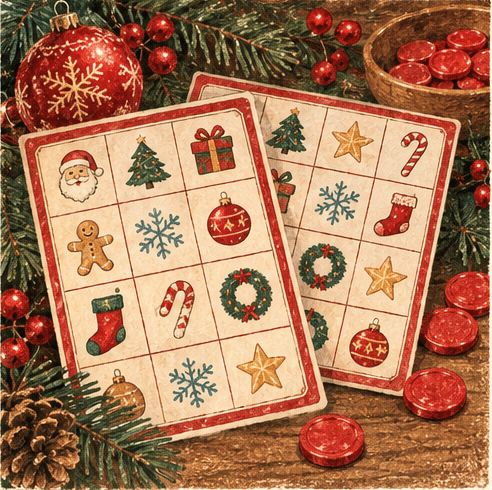
Mark festive pictures or words on your bingo card as they are called, and be the first player to complete the winning pattern.
Sitting downEveryone at onceNo one on the spotA winner

Play here
Pass wrapped gifts left and right as the words appear in a Christmas story, then keep whichever gift ends up in your hands.
Sitting downEveryone at onceNo one on the spotNo winner
Six things a family usually knows before it chooses, and the game in this set that fits each one — chosen from the records, with the reason shown.
When children, adults and older relatives are all playing, the game has to work for the one who is least sure about it. These are the things to look at on each card.
The age on each card is the age at which a child can play properly, not just be present. In this set it runs from 4 to 7. Choose for the youngest player who will genuinely take part; a game pitched at the adults leaves the children as an audience, and an audience of children is a short one.
Some games are one person performing for everyone else — acting, drawing, singing — and some have no spotlight at all. A confident nine-year-old will love the first kind; a shy relative, or a grandparent who did not expect to be the entertainment, will love the second. The trait line on each card says which it is.
A game where everyone plays at the same time — a card to mark, a choice to make, a thing to find — never leaves a six-year-old waiting through six adults’ turns. Where a game takes turns, teams do the same job: a child paired with an adult contributes without carrying the round alone.
6 of these 8 are played from a chair, which is what makes them playable by the relative with the bad knee and the toddler on someone’s lap at the same time. Save the ones that get everyone up for when the room needs it, and go back to the table afterwards.
3 of the eight have no winner: the game ends when it ends, and nobody lost. With very small children, or a competitive streak in the family that has spoiled a Christmas before, that is a feature to choose on purpose.
Four of you around a table is a different evening from fourteen in a living room. Each card gives the smallest and largest group the game works for; a game with no upper limit scales to whoever turns up, and one that needs six will not work with three.
Between the meal and the film, or after the presents and before the walk, a family rarely has more than half an hour. Every game here runs about fifteen to twenty minutes; the card says which. Pick the one that fits the gap rather than the one you would most like to play if there were time.
Some of these are conversation with a structure — a dilemma to argue over, a story to build a sentence at a time. Others are quiet concentration, and others are movement. Match the mood the room is already in; a game that fights the room loses.
3 of these need nothing at all; 2 need something wrapped or printed before you start. Read the trait line and the “you need” on the game’s own page, and decide on the day before rather than the hour before. If the games follow supper on Christmas Eve, an easy Christmas Eve dinner clears the table in time.
These are starting points, not the whole of what a family can play. Every game in the library suits families; the Game Finder asks who is there, how many and what the evening needs, and picks from all twenty-three — or browse the full list with every game’s rules.
Not the one who suggested playing — the one who agreed to. If they can understand the game from one sentence and join in without being watched, everyone else will be fine.
A small child can be the one who draws the next card, keeps the score, or holds the bowl. A grandparent can judge. Nobody has to do the same thing to be playing the same game.
Where a game runs in teams, put a child with an adult rather than the children together. It levels the game and it changes who talks to whom, which is half the point of playing.
After something loud, something seated; after something with a winner, something without one. Two guessing games in a row feel like one long one, however different their rules.
One round more than everyone wanted is what people remember. End when the youngest starts to drift, not when the planned list is finished — the list was for you, not for them.
Every game in the library can be played as a family — quizzes, word games, gift exchanges, games for two and games for a crowd — with full rules, or the Finder to pick one for the people who are actually in the room.
Let the Finder choose