

Christmas Freeze Dance
Dance to Christmas music and freeze the instant it stops—anyone caught moving has to sit out or take a festive challenge.
From age 4On your feetEveryone at onceLittle spotlight
Youngest players first — every one of these starts at four to six, and none needs reading.
A four-year-old and a nine-year-old are not playing the same game even when they are in the same room, so every card here leads with the age it starts at — the age at which a child can play it properly, not just stand nearby. Choose for the youngest child who will genuinely take part, and the older ones will look after themselves.
These 8 are the first games in our library marked for children, youngest first: 4 start at 4, 5 have everyone playing at the same time, and 4 get them moving. None needs reading, and 3 need nothing at all. 14 more of our 23 games suit children too; they are below if these do not fit.
The eight
Players and time from each game’s record, and the four things that decide it for children — the age it starts at, how much they move, whether they all play at once or take turns, and whether one child is put on the spot.
Dance to Christmas music and freeze the instant it stops—anyone caught moving has to sit out or take a festive challenge.
From age 4On your feetEveryone at onceLittle spotlight
Search the room for hidden candy canes and see who can find the most before the hunt ends.
From age 4Up and aboutEveryone at onceNo one on the spot

Play here
Take turns choosing a visible Christmas object and giving clues while everyone else tries to guess what you can see.
From age 4Sitting downQuick turnsLittle spotlight

Play here
Follow Santa’s Christmas commands — but only when the instruction begins with “Santa says.”
From age 4Up and aboutEveryone at onceLittle spotlight
Play here
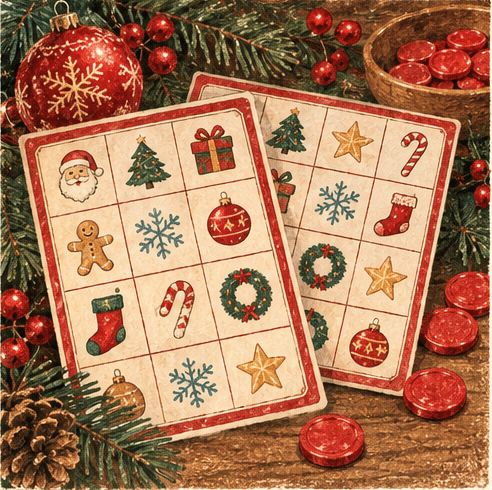
Mark festive pictures or words on your bingo card as they are called, and be the first player to complete the winning pattern.
From age 5Sitting downEveryone at onceNo one on the spot
Play here
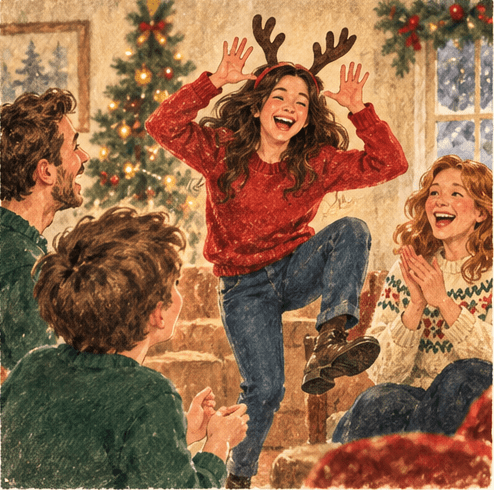
Act out Christmas characters, traditions, songs and festive activities while your teammates race to guess the answer.
From age 6Up and aboutIn teamsSomeone performs

Play here
Choose between two funny or festive Christmas scenarios, then compare answers and explain your choice.
From age 6Sitting downEveryone at onceLittle spotlight

Play here
Draw Christmas characters, objects and festive activities while your teammates race to guess what they are.
From age 6Sitting downIn teamsSome spotlight
Six things you usually know about a room of children before you pick, and the game in this set that fits each one — chosen from the records, with the reason shown.
The age on a card is a floor, not a target. Everything else on the card is about what happens in the first two minutes — because with children, that is the game.
In this set the floors run from 4 to 6. A game that starts at six asks for something — reading a prompt, keeping a secret, acting for an audience — that a four-year-old cannot do yet, and “joining in” without being able to do it stops being fun quickly. A game that starts at four is still a game at nine; the reverse is not true. Settling down afterwards? Our Christmas movies for kids are sorted by age the same way.
5 of the eight have every child playing at the same moment — hunting, marking a card, freezing when the music stops. The others take turns, and a turn is a wait; the trait line says which is which. For a room of small children, “everyone at once” is the single most useful thing on the card.
4 of these get children up and moving and the rest are played sitting down. Choose the one the room needs now — running about before dinner, sitting down after it — and keep one of each kind ready, because the room will change its mind.
2 of the eight put no child in front of the others; one asks a child to act for the room. Some children want exactly that and some will not play if it is asked of them. Where a game has a spotlight, teams put a confident child and a shy one on the same side, and the shy one plays.
Every game here runs about 15 to 20 minutes, and every one can stop at the end of any round without anyone losing anything. Pick for the attention you have, not the attention you hope for.
These are the youngest-starting games in the library, not the only ones for children: 22 of our 23 are marked for kids. The Game Finder takes the ages, the number and the mood and picks from all of them — or browse the full list, where every card shows the age it starts at.
Give the first rule, play a turn, give the next one when it is needed. Children learn a game by playing it, and a full explanation before the first go is the surest way to lose the youngest before it starts.
Hide the candy canes, deal the cards, queue the music before anyone is looking. A room of children waiting for a grown-up to set up is a room that has already started a different game.
A game that runs in rounds can stop after two or go on for six, and the children decide which by how they are behaving. Plan for short and be ready to keep going; never plan for long and try to hold them there.
Where a game runs in teams, put an older child with a younger one. Where it does not, give the child who is not playing well a job — calling the numbers, choosing the next song, hiding the next clue — and they are back in the game.
After a game on their feet, one sitting down; after a winner, one where everyone finds something. Stop a game while they still want more of it, and the next one starts with a room that wants to play.
Every game marked for children, plus the whole library — with the age each one starts at on its card and its full rules — or the Finder to pick one for the children you have.
Let the Finder choose