

Traditions & History
The History of Santa Claus
Santa Claus did not spring fully formed from a single story, tradition or advertising campaign. His journey from a mysterious late-antique bishop to the red-suited visitor of Christmas Eve took more than 1,500 years.
AllForXmas EditorialPublished
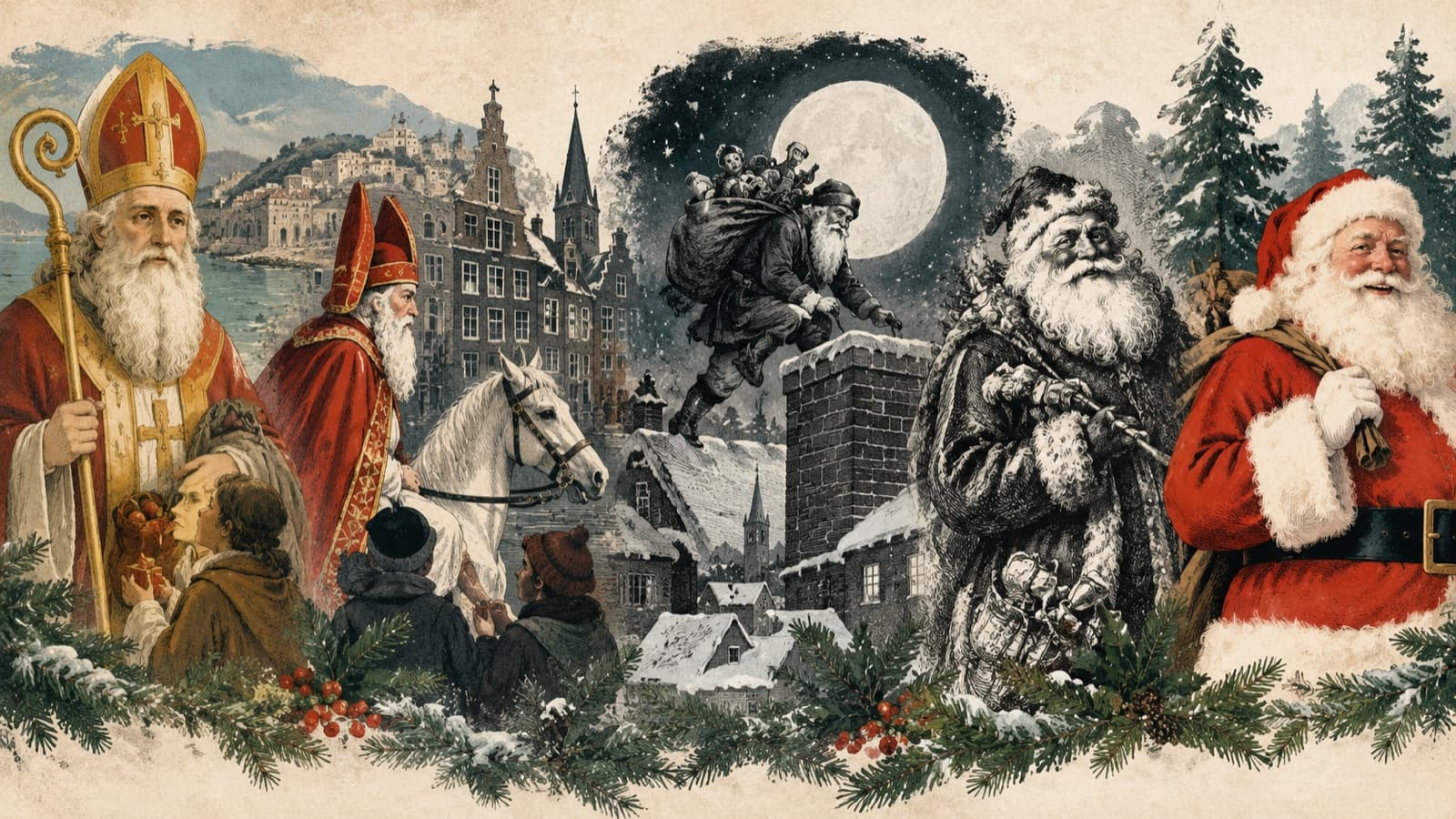
The Santa Claus we recognize today seems to come with a remarkably complete biography.
He lives at the North Pole. He has a workshop, elves and flying reindeer. On Christmas Eve he travels in a sleigh, enters homes through chimneys and leaves presents for children. He is elderly, bearded, cheerful, generously proportioned and usually dressed in red trimmed with white.
Almost none of that belonged to the man at the beginning of Santa’s story.
That man was Nicholas, a Christian bishop associated with the ancient city of Myra, on the Mediterranean coast of what is now Turkey. He lived during the late third and early fourth centuries, but surprisingly little about his life can be established with confidence.
Santa Claus emerged only much later, through a long process of accumulation. Christian devotion turned Nicholas into one of Europe’s most beloved saints. Traditions connected his feast with children and gifts. Dutch culture preserved him as Sinterklaas. Early nineteenth-century New Yorkers reworked that inheritance. Poems and illustrations gave the American Santa his reindeer, sleigh, chimney visits and increasingly familiar appearance. Advertising and mass culture then helped standardize the result.
There was no single moment when Saint Nicholas became Santa Claus.
There were many.
The mysterious bishop behind Santa Claus
Nicholas of Myra is generally treated as a historical Christian bishop associated with Myra in Lycia, part of the Roman Empire in Asia Minor.
Beyond that, the evidence becomes unexpectedly thin.
There is no surviving contemporary biography of Nicholas and no known body of writings by him.See source 1 Later accounts of his life accumulated long after the period in which he lived. Adam C. English, writing in The Oxford Handbook of Christmas, emphasizes how little is known with certainty about the original Nicholas even though later tradition made him one of Christianity’s best-known saints.See source 2
That matters because many details repeated today as biography are actually later tradition.
Nicholas is often assigned exact birth and death years. We do not need them. It is safer and more accurate to place him in the late third and early fourth centuries.
His supposed attendance at the Council of Nicaea in 325 is also difficult to establish securely. Later tradition connected Nicholas with the council, and still later stories transformed that association into the famous tale in which he struck the theologian Arius. Whatever one thinks of the possibility that Nicholas attended, the dramatic assault story belongs to legend rather than contemporary documentation.See source 1
The historical Nicholas therefore remains indistinct.
But the stories told about him became enormously influential.
How Nicholas became a gift-giver
The Nicholas legend most important to Santa’s later history concerns three impoverished daughters.
In the story, their father could not afford the money needed for them to marry. Nicholas secretly provided it, preserving the family from ruin. Later retellings elaborated the episode: the money became bags or balls of gold, delivered anonymously at night and, in some versions, thrown through a window or associated with stockings.
The story survives from later hagiographical tradition rather than contemporary evidence about Nicholas himself.See source 1 But its cultural importance is obvious. It established Nicholas as a figure of secret, nighttime generosity.
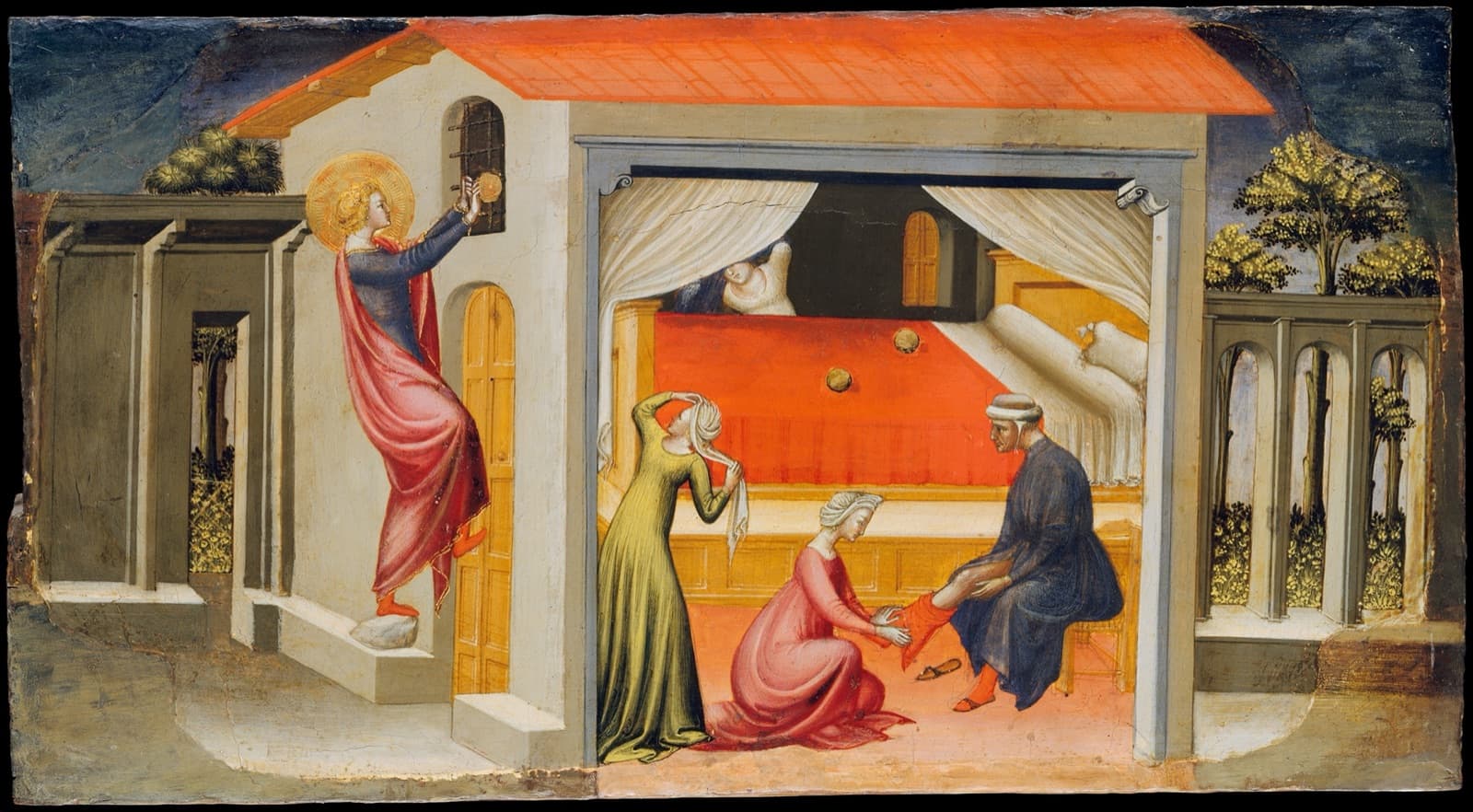
Other stories made him the protector of sailors, children, travelers and people in danger. Over time, those legends mattered at least as much as anything recoverable about the historical bishop.
His cult also expanded geographically.
In 1087, men from Bari in southern Italy carried most of the relics believed to be Nicholas’s from Myra to Bari.See source 1 Medieval Christian writers presented this as a sacred translation; viewed more prosaically, it was a forcible removal of prized relics. Either way, Bari became a major center of Nicholas devotion, and his cult became increasingly important in western Europe.See source 3
By the Middle Ages, the obscure bishop of Myra had become Saint Nicholas, one of Christianity’s most widely venerated saints.
His feast day was December 6.
And that date would matter.
Saint Nicholas, children and December gifts
For centuries, Saint Nicholas Day and Christmas were not the same celebration.
Nicholas had his own feast on December 6. In different parts of Europe, customs developed in which children received treats or gifts connected with the saint around that date.
That distinction is important because the modern Santa arrives on Christmas Eve. Traditional Saint Nicholas customs belonged primarily to the eve or feast of Saint Nicholas.
The move from one date to the other was not a single event. That shift belongs to the wider history of Christmas, which was being rearranged around it.
The Protestant Reformation complicated Nicholas’s position because reformers in many places rejected or discouraged devotion to saints. Yet popular customs did not always disappear simply because religious authorities objected.
Amsterdam offers unusually clear evidence.
After the city became officially Protestant in 1578, authorities tried to suppress Saint Nicholas celebrations. The effort did not erase the feast. The Amsterdam City Archives documents the persistence of popular Saint Nicholas customs and describes children receiving things such as nuts, cakes, toys and other gifts in their shoes.See source 4
The Dutch figure became known as Sinterklaas, a form derived from Sint Nicolaas.
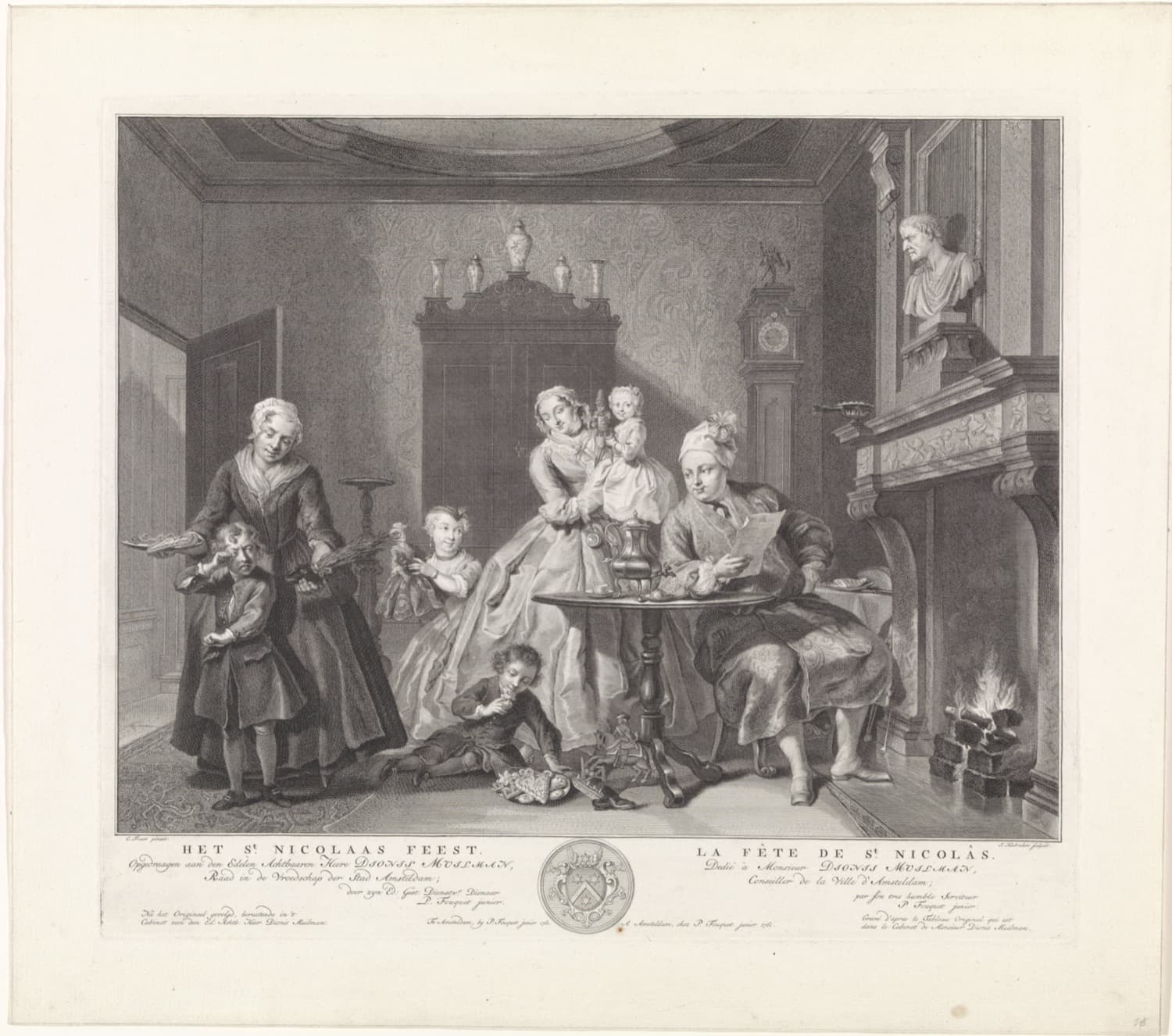
Here we can recognize several pieces of the later Santa tradition: a mysterious visitor, children, gifts, behavior and the expectation that something might appear overnight.
But Sinterklaas was not yet simply the modern American Santa under another name.
The next transformation took place in New York.
Did the Dutch bring Santa Claus to New York?
The familiar story is wonderfully neat:
Dutch settlers brought Sinterklaas to New Amsterdam in the seventeenth century. The English later renamed the colony New York. “Sinterklaas” became “Santa Claus,” and the old Dutch custom gradually evolved into the American figure we know.
The reality appears much less continuous.
Historian Charles W. Jones argued in his influential 1954 study Knickerbocker Santa Claus that the American Santa was not simply a colonial Dutch custom preserved intact into the nineteenth century. Instead, early nineteenth-century New Yorkers were actively reconstructing and romanticizing the city’s Dutch past.See source 5
That interpretation also fits the broader argument made by historian Stephen Nissenbaum: the St. Nicholas/Santa tradition that emerged in New York was, in important respects, a self-conscious cultural construction rather than the untouched survival of old New Amsterdam.See source 6
Two figures were especially important.
One was John Pintard, an antiquarian and founder of the New-York Historical Society. He promoted Saint Nicholas as a patron connected with New York’s Dutch heritage.
The other was Washington Irving.
In 1809, Irving published his comic A History of New York from the Beginning of the World to the End of the Dutch Dynasty, attributed to the fictional historian Diedrich Knickerbocker. The book playfully invented and embellished a Dutch colonial past in which Saint Nicholas appeared as part of the mythology of old New Amsterdam.
The point is not that Irving recorded a surviving custom.
He was helping create a usable Dutch-American past.
A year later, the New-York Historical Society held a Saint Nicholas dinner. Pintard commissioned engraver Alexander Anderson to create an image for the occasion.
The 1810 broadside is a remarkable transitional object.
Nicholas still looks like a bishop. But beside him is a domestic fireplace with stockings. One receives rewards for a good child; another carries punishment for a badly behaved one.See source 7
The saint is entering the American household.
But he has not yet become Santa.
Then Santa got a sleigh
The transformation accelerated.
In 1821, a small illustrated children’s publication called The Children’s Friend presented “Santeclaus” as a Christmas Eve gift-giver traveling in a reindeer-drawn vehicle.
This is a crucial piece of evidence because it predates the famous 1823 poem by two years.
The American Antiquarian Society’s Christmas collection notes that a reindeer already appears with Santa in The Children’s Friend, despite the later tendency to credit A Visit from St. Nicholas with introducing reindeer to Santa’s sleigh.See source 8
The 1821 figure travels across the winter night, brings gifts to children and is associated with Christmas Eve rather than December 5.
In other words, several ingredients we now think of as quintessential Santa were already being assembled before 1823.
Then came the poem that made the combination famous.
The poem that put Santa on the roof
On December 23, 1823, the Troy Sentinel in New York published an anonymous poem titled “A Visit from St. Nicholas.”
Today it is better known by its opening: ’Twas the night before Christmas.
The New York State Library confirms that the poem appeared anonymously in that issue of the Troy Sentinel.See source 9 It was later attributed to Clement Clarke Moore, although a longstanding competing claim has been made for Henry Livingston Jr.See source 10
The authorship dispute is interesting, but the poem’s cultural effect does not depend on resolving it.
Its Saint Nicholas arrives in a miniature sleigh pulled by eight reindeer. He lands on the roof, enters through the chimney, carries a sack of toys, fills stockings and disappears up the chimney before flying away.
He is also becoming more recognizable as a character: lively, bearded, round-bellied and cheerful.
But the poem did not invent everything it described.
A reindeer-drawn gift-giver had already appeared in 1821. Pintard’s 1810 broadside had already connected Nicholas with stockings, rewards and children’s behavior. Irving had already embedded St. Nicholas in an imagined Dutch New York.
What A Visit from St. Nicholas accomplished was different and arguably more important.
It assembled an extraordinarily durable Santa scene and carried it into popular culture.
The roof.
The chimney.
The stockings.
The sleigh.
Eight named reindeer.
Christmas Eve.
A magical, cheerful gift-giver.
Two centuries later, much of the basic script remains unchanged.
Thomas Nast gives Santa a world
Words could tell readers what Santa did.
Mass-produced illustration could show them what he looked like and where he belonged.
No nineteenth-century illustrator mattered more to that process than Thomas Nast.
His Santa Claus in Camp, published in Harper’s Weekly during the Civil War and dated January 3, 1863, shows Santa visiting Union soldiers.See source 11 The figure is already recognizably derived from the American St. Nicholas tradition, but Nast did not produce one definitive Santa and stop. He returned to the character repeatedly over decades.
Those images helped make Santa visually coherent.
They also expanded his mythology.
Nast is strongly associated with placing Santa at the North Pole. Later Nast imagery and commentary helped popularize Santa’s northern home and the larger world around him.See source 12
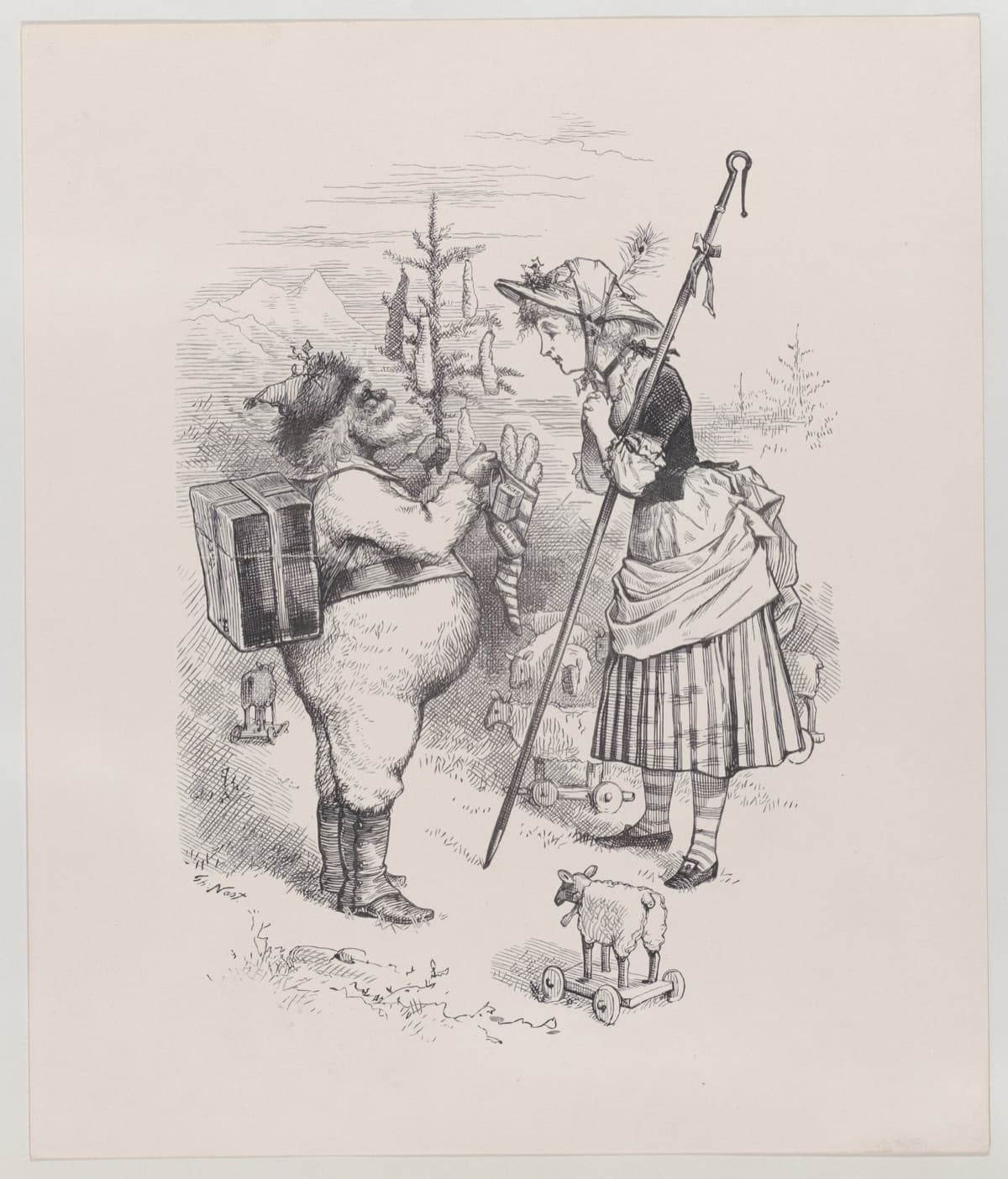
Nast also drew Santa dealing with children’s letters and behavior, reinforcing the idea that Santa did not merely deliver gifts—he kept track of the children receiving them.
Yet “Thomas Nast invented the modern Santa” is still too neat.
His Santas changed from image to image. Other artists, publishers, card makers and advertisers kept reshaping the figure.
By the late nineteenth century, Santa no longer belonged to any one writer or illustrator.
He belonged to mass culture.
Santa before Coca-Cola
This is where one of the most persistent Christmas myths falls apart.
Coca-Cola did not invent Santa Claus.
Nor did it take an unfamiliar figure and suddenly create the Santa we recognize today.
The Smithsonian traces Santa’s visual development well before Coca-Cola’s famous campaign. By the 1860s, Nast had already developed a human-sized Santa, and by the 1910s and 1920s the jolly, white-bearded figure had largely come into recognizable focus, even though details such as clothing and body shape still varied.See source 13
Santa was also already part of commercial culture.
Cards, books, magazines and advertising repeatedly reproduced him. Department stores increasingly made Christmas into a visual destination, with Santa parades, toy departments and seasonal displays bringing the character into the retail experience.See source 14
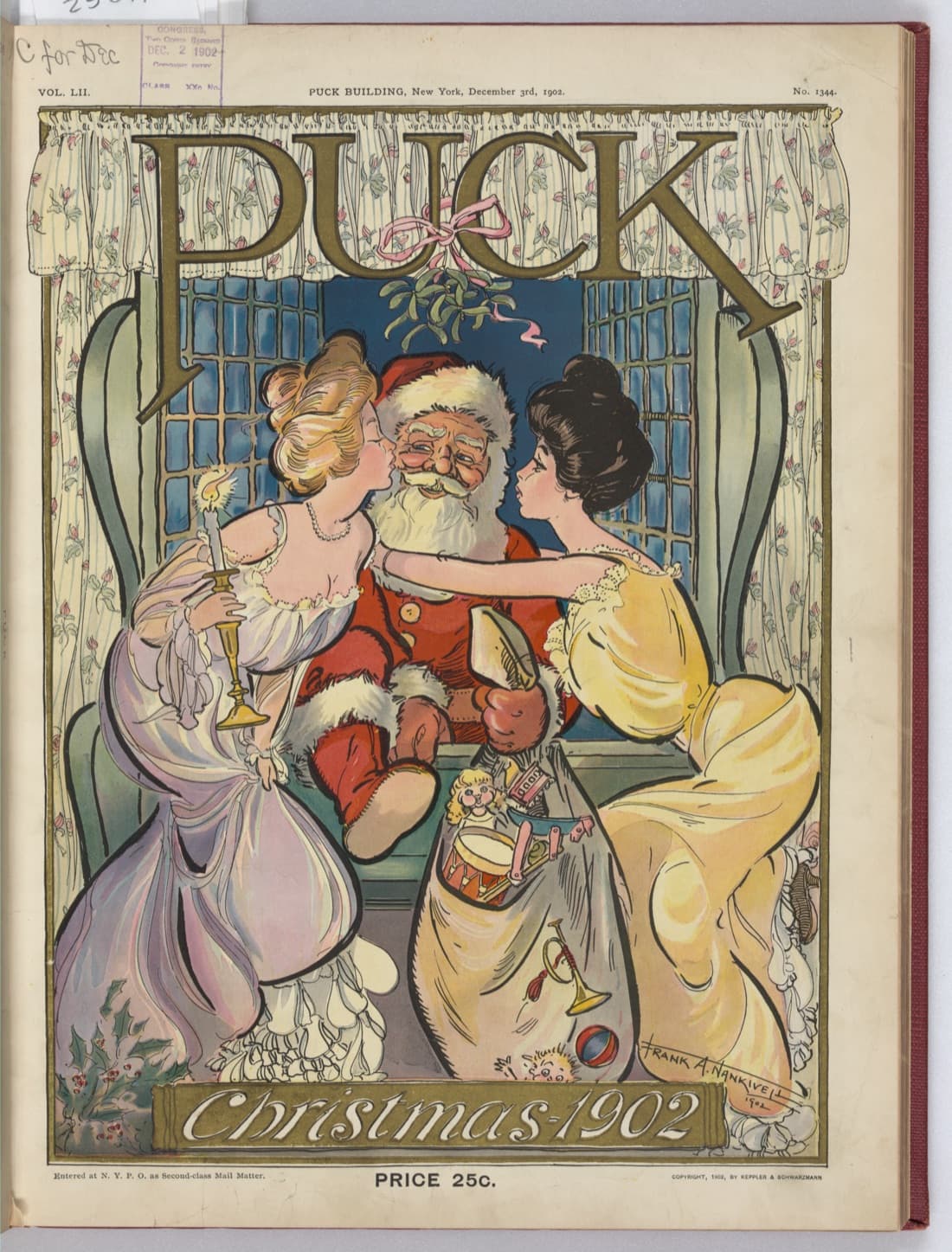
So by the beginning of the twentieth century, no advertising campaign was starting from scratch.
The visual vocabulary was already there.
What Coca-Cola actually did to Santa
In 1931, Coca-Cola began using Santa illustrations by Haddon Sundblom in a major advertising campaign.
Sundblom painted Santa as large, warm and strikingly human: white beard, rosy face, ample belly and red coat trimmed in white.
The campaign became extraordinarily familiar.
But Sundblom inherited a century of development. The Smithsonian explicitly places Coca-Cola’s Santa after the nineteenth-century literary and visual construction of the character and notes that red-and-white Santa imagery existed before the 1931 campaign.See source 13
So Coca-Cola deserves real credit, but different credit from the myth.
It did not invent Santa Claus.
It did not transform Saint Nicholas directly into Santa.
And it was not the origin of the idea that Santa could wear red.
What Coca-Cola did was help standardize and disseminate one especially memorable version of a figure that American culture had already spent more than a century constructing.
That is a more historically interesting achievement than invention.
Santa was still changing
Even after Coca-Cola’s Santa became familiar, the mythology was not finished.
Consider the most famous addition to the reindeer team.
Dasher, Dancer, Prancer, Vixen, Comet, Cupid, Donner and Blitzen belong to the nineteenth-century Santa tradition.
Rudolph does not.
Rudolph the Red-Nosed Reindeer was created by Robert L. May for the department store Montgomery Ward in 1939 as the central character of a promotional children’s booklet.See source 15
A decade later, May’s brother-in-law Johnny Marks turned Rudolph into a song, and Gene Autry’s 1949 recording helped turn the character into a permanent part of Christmas culture.See source 16
Rudolph matters precisely because he arrived so late.
Santa had been riding behind reindeer for more than a century before Rudolph joined the team.
Yet today Rudolph can seem almost timeless.
Traditions can acquire the appearance of antiquity surprisingly quickly.
What about Father Christmas?
Britain had its own figure: Father Christmas.
His history was not originally the same as Saint Nicholas’s.
Earlier Father Christmas represented the Christmas season itself—especially feasting, hospitality and good cheer—rather than functioning primarily as a children’s gift-giver. During the nineteenth century, Father Christmas became more closely associated with the family Christmas and with presents.See source 17
At the same time, American Santa imagery became increasingly influential.
Eventually the two traditions converged so thoroughly that “Father Christmas” and “Santa Claus” can now function as near-synonyms in Britain.
They did not begin that way.
That convergence is another reminder that Santa’s history is not one unbroken genealogical line.
Traditions met, borrowed, merged and changed.
So who invented Santa Claus?
No one did.
The historical Nicholas supplied the name and foundation of a saintly tradition.
Centuries of Christian devotion supplied legends of generosity, protection and miraculous help.
European customs connected Saint Nicholas with children and December gifts.
Dutch culture preserved and reshaped Nicholas as Sinterklaas.
Early nineteenth-century New Yorkers such as John Pintard and Washington Irving reworked St. Nicholas as part of a newly imagined Dutch-American heritage.
The Children’s Friend put a reindeer-drawn Christmas Eve gift-giver on the rooftops.
A Visit from St. Nicholas assembled many of Santa’s most enduring characteristics and carried them into popular culture.
Thomas Nast repeatedly visualized the character and helped give Santa a North Pole world.
Late nineteenth- and early twentieth-century publishing, retailing and advertising multiplied his image.
Haddon Sundblom and Coca-Cola helped standardize one exceptionally influential version.
Robert L. May added Rudolph as late as 1939.
Santa Claus was not invented.
He accumulated.
That may be the most Christmas-like thing about him.
Christmas itself developed through centuries of adoption, resistance and reinvention. Santa did too.
Each generation inherited something older, changed it, added something new—and then passed the result onward as though it had always been there.