

Traditions & History
The History of Christmas
Christmas did not arrive fully formed. The holiday took shape over many centuries, as a Christian feast absorbed, resisted and reinvented the customs around it.
AllForXmas EditorialPublished
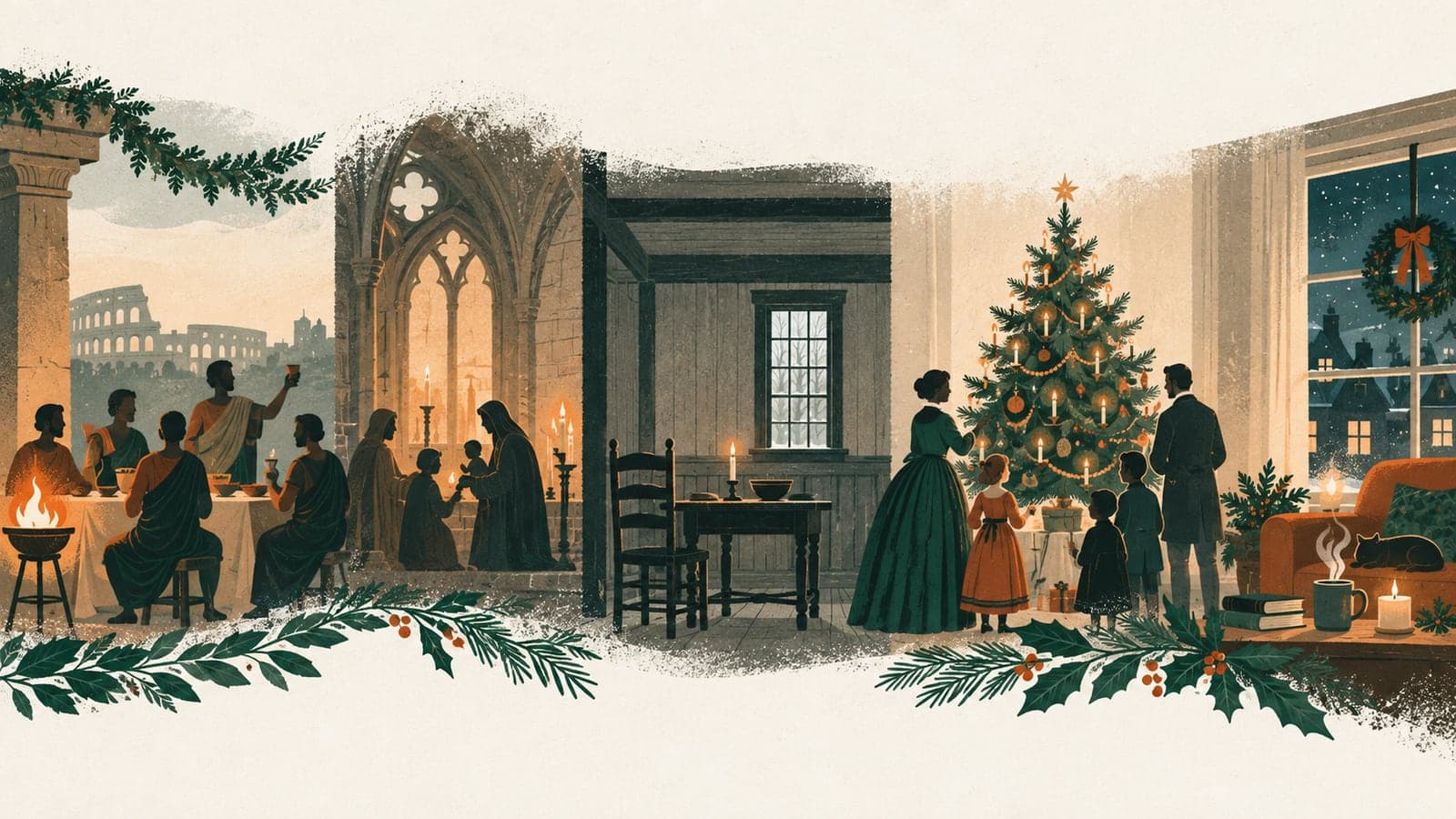
Christmas is a Christian feast marking the birth of Jesus. That much is simple. Almost everything else about its history is a story of accumulation — a date that had to be settled, customs that arrived from elsewhere, long arguments about whether the feast should exist at all, and a nineteenth-century reinvention so thorough that much of what feels timeless about Christmas is younger than the railways.
Where Christmas begins
The Gospels describe the birth of Jesus but never say when in the year it happened. For the earliest Christians this was not a gap needing to be filled, because the nativity was not the event they gathered to mark. Easter was.
A feast of the nativity came later, and the earliest surviving record of it being kept on 25 December comes from Rome in the middle of the fourth century.See source 1 That is roughly three hundred years after the events it commemorates — long enough for the question of how the date was chosen to have no simple answer, and long enough for the answers people confidently give to be worth examining.
How December 25 became Christmas
This is the part of Christmas history most often explained badly. The usual account — that the church picked a pagan festival and overwrote it — is tidier than the evidence, and so is its opposite. It is worth separating what a document actually records from what historians infer from it.
The earliest secure evidence
The Chronography of 354 is a Roman almanac compiled for a wealthy Christian named Valentinus. In its calendar, against the eighth day before the kalends of January — 25 December — it records the birth of Christ in Bethlehem.See source 1 It is the oldest surviving evidence for Christmas as an annual feast on that day.
“Oldest surviving” is doing real work in that sentence. It tells us the feast was established in Rome by 354. It does not tell us when the practice began, only when our evidence for it begins — and it says nothing whatever about why.
Saturnalia and Roman winter festivals
Rome’s midwinter was busy, and the best known of its festivals was Saturnalia. It is easy to see why it is the one most often named as Christmas’s ancestor: it ran on public banquets and private feasting, on presents of candles and small earthenware figures, and on a licensed inversion of the ordinary order in which slaves wore their masters’ clothes and were waited on at table.See source 2
The difficulty is the calendar. Saturnalia began on 17 December and, by Cicero’s day, ran to the 23rd — close to Christmas, but not on it.See source 2 The point is sharpened by the Chronography itself, which records Christmas on 25 December while still placing Saturnalia on the 17th.See source 2 The two festivals sat in the same crowded winter and stayed distinct. Proximity is not descent, and a festival that ends two days before another begins has not been renamed.
Sol Invictus
The stronger version of the argument concerns a different festival. The same Chronography of 354 marks 25 December as the Natalis Invicti — the birthday of the Unconquered Sun.See source 1 One document, one date, two celebrations.
That coincidence has powered a century of argument, and it genuinely cuts both ways. It might mean the Christian feast was placed to answer a popular solar festival. It might mean the solar festival was elevated in response to a Christian one already gathering strength. The document tells us the two coincided. It does not tell us which came first, or whether either caused the other.
The Christian calculation theory
The main alternative involves no borrowing whatever. Some early Christians worked out the date of the nativity from theological chronology rather than from anyone else’s calendar — reasoning from a computed date for the crucifixion, on the premise that a perfect life would span a whole number of years from conception to death. Run that calculation and 25 December falls out of it.
This has been the principal rival to the history-of-religions explanation for over a century, and both have serious scholarly support.See source 3 It has the advantage of explaining the date without requiring a pagan festival at all, and the disadvantage that we cannot show it was actually the reasoning anyone used.
What historians can actually say
No surviving contemporary document explains why 25 December was chosen. Not one. Everything beyond that is inference from later evidence, and the two main explanations have been argued back and forth for more than a hundred years without either winning. Recent research has unsettled the confident forms of both.See source 4
That is genuinely the state of the question, and it is more interesting than a verdict. Christmas was fixed to a date in a Roman winter already full of meaning, by people who left no note explaining themselves.
Did Christmas come from pagan traditions?
Christmas took shape in societies that already marked midwinter. Rome had its winter festivals; northern Europe had its own. Bringing greenery indoors, lighting the dark end of the year and feasting while the stores held out were all long established by the time Christmas came to be kept among them.
The trouble starts when adaptation is mistaken for descent. Evergreens meant something before Christianity and went on meaning something after it, but continuity of material is not continuity of ritual. By the late Middle Ages almost every surviving English church record includes payments for holly and ivy bought for the winter feast.See source 5 That is Christian practice using familiar plants, not a pagan rite in disguise.
Mistletoe is the clearest warning. Pliny the Elder described Druids in Gaul cutting mistletoe from oak trees, and the passage is quoted constantly as the origin of a Christmas custom. But Pliny mentioned neither Britain nor the winter season; nineteenth-century antiquarians supplied both, and we still do not know whether the association between mistletoe and Christmas is a seventeenth-century development or an older one that simply went unrecorded.See source 5
The honest shape of this story is interaction and reinterpretation. Christmas grew inside cultures that already marked midwinter, took some of their materials, and gave them new meanings. That is how festivals normally work. It is not the same as a holiday being copied.
Christmas in the Middle Ages
By the Middle Ages Christmas was not a day but a season, and observance opened on Christmas Eve.See source 6 The twelve days themselves are counted from Christmas Day, running to Twelfth Night on 5 January and closing at Epiphany on the 6th.See source 7 Medieval Christmas is best understood as a period of time rather than a date in it.
It was, first, a religious season. Churches marked Christmas as one of the great turning points of the year, alongside Lent and Easter.See source 8 The story was told in the buildings themselves — in embroidered vestments and altar hangings, where nativity scenes were dressed in the architecture and furnishings of the workshops that made them.See source 6
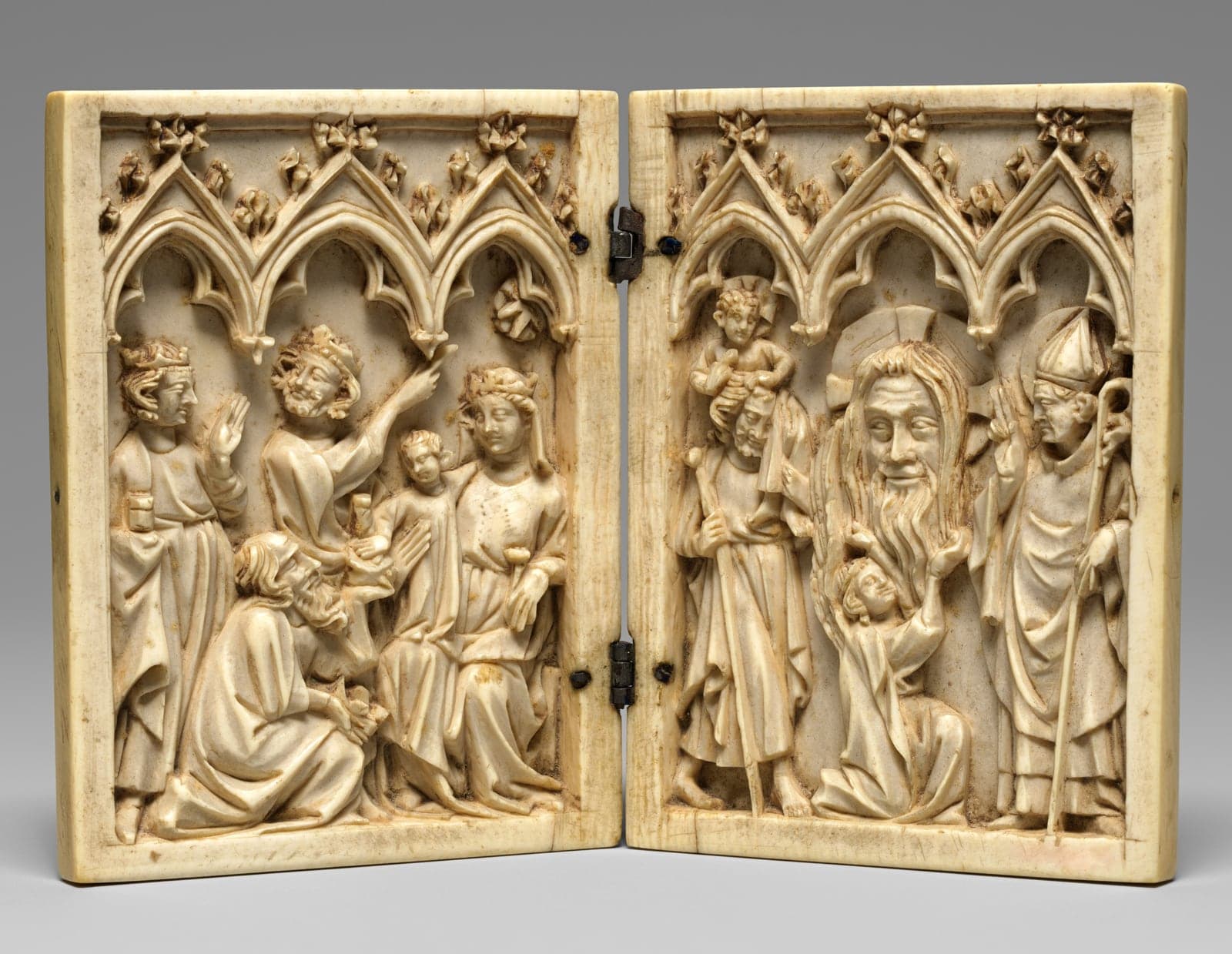
It was also a genuine holiday, and one that reached further down the social order than people expect. The twelve days released schoolboys, monks and even unfree peasants from their ordinary obligations, and the wealthy were expected to feed those below them.See source 9 Worship and revelry ran together rather than in opposition: night and early-morning services on the one hand, eating, drinking and playing on the other.
Two details separate it sharply from the modern holiday. Gift-giving mattered far less than it does now, and what there was of it fell at New Year rather than on Christmas Day.See source 9 And the season made room for organised misbehaviour — most notably the Feast of Fools, in which clergy suspended the ordinary rules and briefly inverted their own hierarchy.See source 9 A licensed interval of disorder was part of how the season worked, not a lapse in it.
Why some Protestants rejected Christmas
The Reformation put that arrangement under pressure. To reformers of a stricter cast, Christmas had two problems. Scripture nowhere commands a feast of the nativity, which made it a human addition to divine worship. And the season as actually practised — twelve days of eating, drinking and licensed misrule — looked less like devotion than an annual excuse.
The objection, in other words, was not to Christ’s birth. It was to the argument that a church may institute holy days God did not ask for, and to what those days had become in practice. That distinction matters, because what followed in England is usually told as an attack on Christmas itself.
When Christmas was actually banned
Christmas really was suppressed in England, and the popular version of how is wrong in almost every particular.
It was Parliament’s doing, not one man’s. Restrictions began in 1644, when Christmas Day fell on a monthly fast; the Directory of Public Worship removed the Christmas service the following year; and in June 1647 Parliament passed an ordinance banning the festivities outright.See source 10
Oliver Cromwell, whose name is attached to all of it, had very little to do with it. He was preoccupied with the war, and when the decisive 1647 ordinance passed he was not even in Parliament. He never repealed it either, and as a Puritan he may well have approved — but he left no opinion on it in any letter or speech, so we simply do not know.See source 10 The man did not ban Christmas; a Parliament he often was not sitting in did.
Nor did it work. Seventeenth-century England had no police force and no machinery for enforcing a ban on private celebration, and by 1656 Parliament was complaining that people were ignoring it — in London, under its own windows.See source 10
The American strand is separate, later and legally sharper. In May 1659 the General Court of the Massachusetts Bay Colony fined anyone found “observing any such day as Christmas or the like, either by forbearing of labor, feasting, or any other way” five shillings.See source 11 That law was repealed in 1681 under pressure from London, but the attitude behind it long outlasted it: Christmas did not become a Massachusetts state holiday until 1856.See source 11 In a large part of New England, Christmas was not so much banned as simply not kept, for two centuries.
How Christmas changed in the 1800s
Christmas survived the seventeenth century, but as a quieter and more local affair. What made it the holiday we would recognise happened in the nineteenth — and happened fast, in perhaps forty years, mostly in Britain and the United States.
The change had a direction. Christmas turned inward, from a communal season of hospitality into a domestic one built around the family and, increasingly, around children. At the same time it became something you could buy.
Family, children and the changing Christmas ideal
The Victorian Christmas was not a revival of the medieval one. It was a new thing wearing old clothes: a festival of the household, of the parlour and the dinner table, aimed at children in a way no earlier Christmas had been. In America the change went furthest. An occasion once associated with public drinking and disorder was remade as a festival of domesticity and consumption, with presents for children moving to the centre of it — a nineteenth-century construction rather than an inheritance.See source 12
The famous set pieces of the Victorian Christmas are best read as symptoms of that shift rather than causes of it. Something was already changing about how families understood the season. What the 1840s added was the means to spread it — the pictures, the books and the printed conventions by which a private ideal became a general one.
Dickens and A Christmas Carol
A Christmas Carol appeared in December 1843 and sold out before Christmas Day.See source 13 Dickens had been turning over the plight of poor children, and the book channelled it into a ghost story about a rich man who learns to keep Christmas properly.
It did not invent Christmas, and it did not invent charity. What it did was fix an image of what Christmas ought to feel like — domestic, generous, warm, alert to the people it excludes — in a form millions of readers absorbed at once — and which adaptation after adaptation has kept in circulation ever since.See source 13
Victoria, Albert and the Christmas tree
Prince Albert is routinely credited with bringing the Christmas tree to Britain. He did not. Queen Charlotte, German-born like Albert, had a decorated tree at Windsor in 1800.See source 14
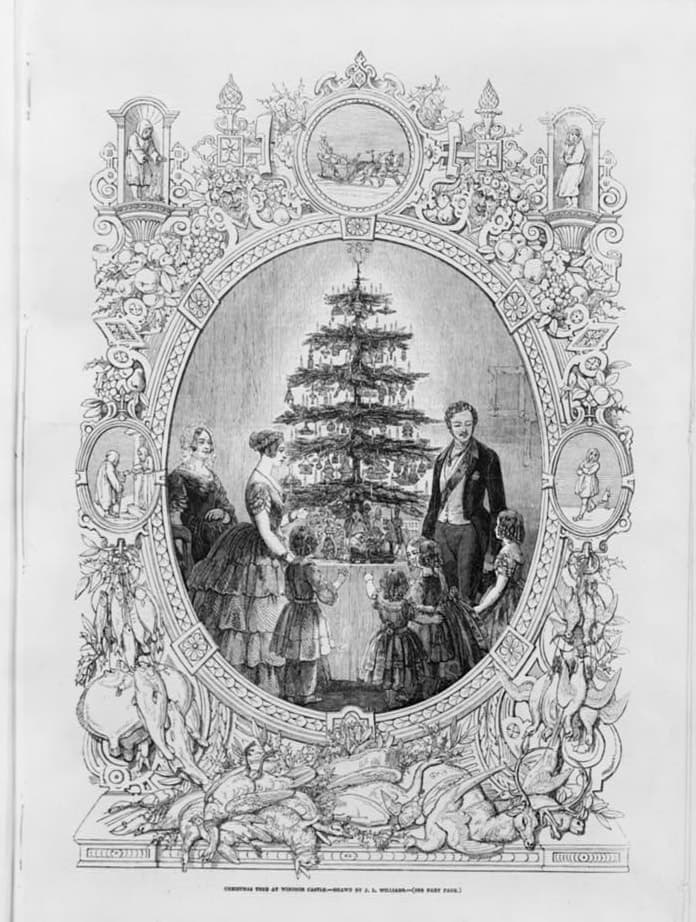
What Victoria and Albert did was more consequential than introducing it. In the 1840s an engraving of the royal family standing around a decorated tree with their children was published in the press, and the fashion moved out of aristocratic houses and into ordinary ones.See source 14 The distinction between introducing a custom and popularising it is the whole story here — and the mechanism was mass-circulation print, which is the century’s real contribution to Christmas.
The first Christmas cards
The same year as A Christmas Carol, and from the same instinct that Christmas was something you now performed at a distance, came the Christmas card. Henry Cole — later the founding director of the V&A — had more seasonal correspondence than he could answer, and asked the artist John Callcott Horsley to design something he could send instead. A thousand were printed at a shilling apiece, which was expensive, and it was not a commercial success.See source 15 The card Horsley sent to Cole himself survives in the V&A’s collection.See source 16
Horsley’s design is a good picture of where Christmas had arrived: three generations of one family raising a toast in the centre, framed by scenes of charity. Domesticity and giving, printed and posted.
How Saint Nicholas became Santa Claus
Santa Claus has the most confidently told and least reliable origin story in Christmas. The usual version runs in a straight line from a fourth-century bishop to a department-store grotto. Followed backwards, it comes apart in a more interesting way.
Start at the far end. Nicholas was a bishop of Myra, in what is now Turkey, in the fourth century — and that is close to everything securely known about him. No contemporary biography survives, no letters, no writings. The earliest known reference dates to around 440 and already carries material that is plainly legend; the first full life was written around 700, roughly three centuries after he died, by an author whose sources cannot be traced.See source 17 Around that very thin core an enormous devotional tradition gathered across medieval Europe: miracles, patronages, feast-day customs, and gifts given on his day in early December. The Dutch Sinterklaas belongs to that tradition, and is the figure usually said to have crossed the Atlantic with Dutch settlers and become Santa Claus.
It is that last step that gives way. Searching the record of Dutch New Amsterdam, Charles W. Jones found no trace of St Nicholas in juvenile literature, periodicals or diaries through the whole period of Dutch rule; on his account the figure was revived by John Pintard from the 1790s as a civic symbol for New York, and it was Washington Irving’s satirical Knickerbocker History of 1809 that made him spread.See source 18 Jones was writing in 1954 and his is one historian’s reading, but the broad shape has held. Stephen Nissenbaum’s later account likewise presents the nineteenth-century American Christmas — St Nicholas, the tree, the presents — as substantially built rather than inherited.See source 12
So the American Santa Claus was assembled in early nineteenth-century New York out of Dutch and St Nicholas material, by people with a deliberate interest in the city’s Dutch past. A revival and a reconstruction, not a handover.
The imagery arrived just ahead of the poem that spread it. In 1821 a New York children’s book, The Children’s Friend, printed the first pictures of an American “Santeclaus” arriving on Christmas Eve in a sleigh drawn by a flying reindeer.See source 19
Two years later came A Visit from St Nicholas, published anonymously in a Troy newspaper on 23 December 1823. It was credited to Clement Clarke Moore only years afterwards, and a rival claim for Henry Livingston Jr. has never been settled.See source 20 Whoever wrote it, the poem did not invent the sleigh or the reindeer. It carried them to an audience the picture book had never reached, and did much to settle which version of Santa Claus would last.
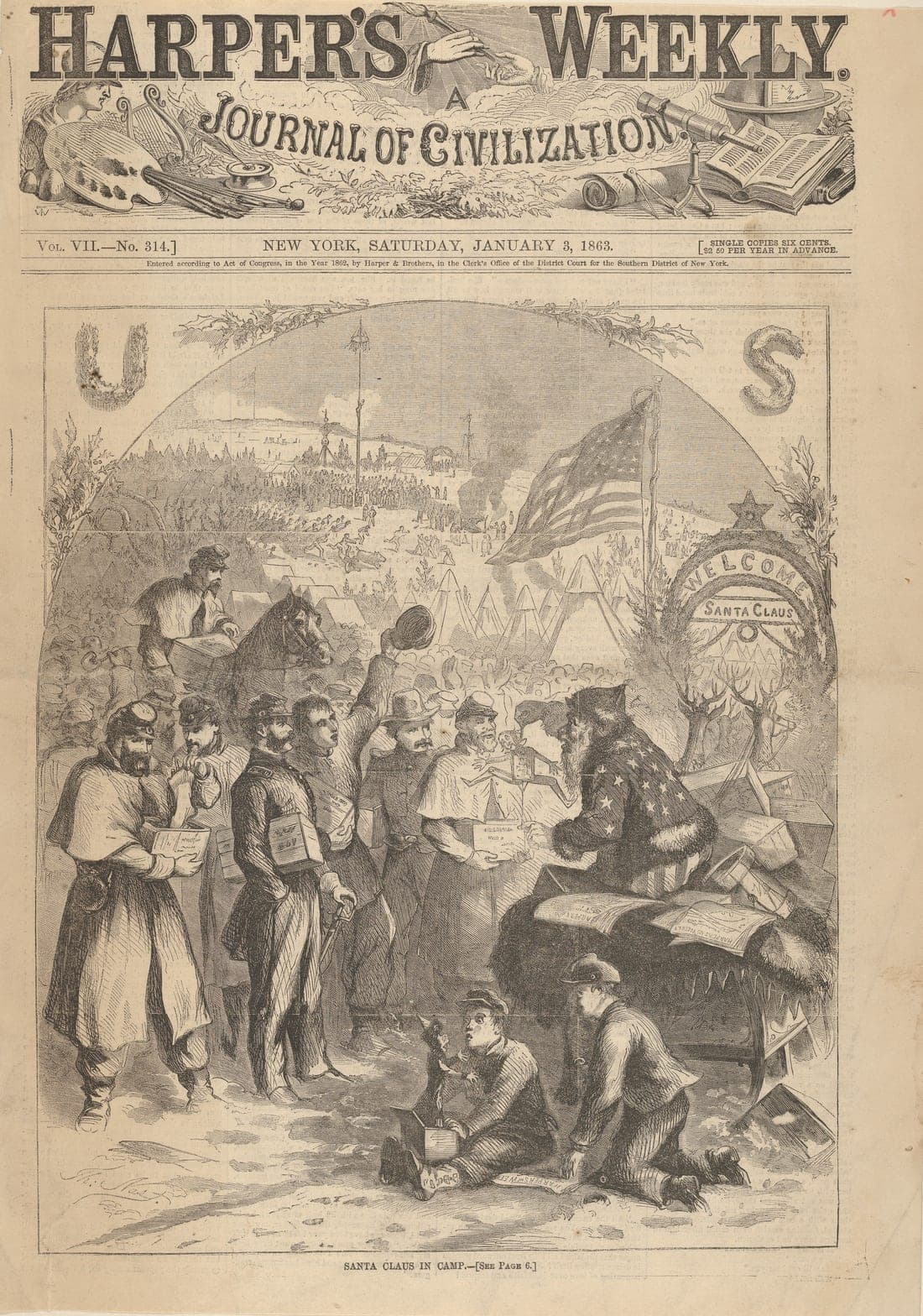
Four decades later the cartoonist Thomas Nast gave the figure a face: his first Santa appeared in Harper’s Weekly on 3 January 1863, in a Union army camp, and he drew thirty-three in all before he was done in 1886.See source 21
Which disposes of the myth that will not die. Coca-Cola did not invent Santa Claus, and did not put him in red. The white-bearded, portly, fur-trimmed figure was already standardised through the nineteenth century; Coca-Cola’s advertising from the 1930s took an image that existed and made it ubiquitous.See source 22
The history of Santa Claus is an equally layered one, running from Saint Nicholas and Dutch Sinterklaas to nineteenth-century New York, Thomas Nast and mass advertising.
How Christmas became the modern holiday we know
Everything the Victorians assembled needed a machine to distribute it, and the nineteenth century built one. Cheap printing carried the royal tree into ordinary homes and Dickens into ordinary hands. Industrial production made ornaments, toys and cards affordable. Railways moved both the goods and the families. Department stores and advertising pushed it further still, and by the early twentieth century a recognisably modern Christmas — decorated, gift-centred, aimed at children, commercially supplied — was in place across much of the English-speaking world.
What survived is not one holiday but several, sharing a date. Christmas is still a liturgical feast. It is also a domestic ritual with no religious content for many of the people who keep it, a commercial season, and in many countries a civic holiday. Those versions have coexisted, uneasily and productively, for well over a century, and the arguments between them are not new either — the seventeenth century had them too, with more at stake.
The through-line is that Christmas has never stopped being assembled. The feast was fixed to a date nobody explained. The season absorbed the midwinter customs around it. It was suppressed, ignored, revived and rebuilt, and the version that feels most eternal — tree, cards, presents, Santa — is largely the work of a few decades in the 1800s. A holiday that has been remade this often is not likely to have finished.
Christmas history timeline
- 354
- A Roman almanac records the birth of Christ on 25 December, the earliest surviving evidence for the feast, and marks the same day as the birthday of the Unconquered Sun.
- c. 440
- The earliest known reference to Nicholas of Myra, already carrying legend.
- 1320–30
- English embroiderers work the nativity into vestments such as the Toledo Cope.
- 1644
- Parliament’s first restriction on Christmas, falling on a monthly fast day.
- 1645
- The Directory of Public Worship removes the Christmas service.
- June 1647
- Parliament bans Christmas festivities outright.
- 1656
- Parliament complains that the ban is being ignored.
- May 1659
- Massachusetts fines the keeping of Christmas five shillings.
- 1681
- The Massachusetts law is repealed under pressure from London.
- 1790s
- John Pintard revives St Nicholas as a civic symbol for New York.
- 1800
- Queen Charlotte has a decorated Christmas tree at Windsor.
- 1809
- Washington Irving’s Knickerbocker History spreads the New York Santa Claus.
- 1821
- The Children’s Friend prints the first pictures of Santa arriving on Christmas Eve in a reindeer-drawn sleigh.
- 1823
- A Visit from St Nicholas is published anonymously in Troy, New York.
- December 1843
- A Christmas Carol is published, and the first commercial Christmas card is printed.
- 1840s
- An engraving of the royal family around their tree carries the custom nationwide.
- 1856
- Christmas becomes a state holiday in Massachusetts.
- 3 January 1863
- Thomas Nast’s first Santa Claus appears in Harper’s Weekly.